
Every time you pick up a new prescription, there’s a small paper booklet tucked into the bag-maybe you’ve seen it, maybe you’ve tossed it. But that little guide isn’t just junk mail. It’s a Medication Guide, and it could save your life.
What Exactly Is a Medication Guide?
A Medication Guide is a printed handout that comes with certain prescription drugs. It’s not the same as the tiny label on your pill bottle. It’s not a general advice sheet from the pharmacy. It’s an official, FDA-approved document that tells you, in plain language, what you need to know about the risks of your medicine. The U.S. Food and Drug Administration (FDA) requires these guides for about 150 prescription drugs-mostly those with serious, potentially life-threatening side effects. Think opioids, certain antidepressants, biologics for autoimmune diseases, and cancer treatments. These aren’t drugs you take for a cold. These are drugs where misunderstanding the risks can lead to hospitalization-or worse. Manufacturers create the guides, but the FDA reviews and approves every word. That means you’re getting accurate, verified information, not marketing fluff. And by law, your pharmacist must give you one every time you fill or refill the prescription-even if you’ve taken it before.Why the FDA Demands These Guides
The FDA doesn’t ask for these guides lightly. They’re a direct response to real harm. In the early 2000s, patients were getting seriously hurt because they didn’t understand how dangerous some medications could be. One person might take a drug that interacts badly with another medication they’re on. Another might ignore early warning signs because they didn’t know what to look for. That’s why the FDA created 21 CFR Part 208-the rules that make Medication Guides mandatory. The agency says a guide is needed if:- The drug has serious risks that could affect whether someone chooses to take it
- Patient behavior (like taking it correctly or watching for side effects) is critical to safety
- Patients need clear information to avoid dangerous reactions
What’s Inside a Medication Guide?
These guides aren’t vague. They follow strict FDA formatting rules to make sure you can actually understand them. Here’s what you’ll find in every one:- The brand name and generic name of the drug
- What the drug is approved to treat
- Who should NOT take it (contraindications)
- The most serious side effects-bolded and easy to spot
- How the drug might interact with other medicines, foods, or supplements
- What to do if you miss a dose
- How to store and dispose of the medication safely
- When to call your doctor right away
Do People Actually Read Them?
Let’s be honest. Many don’t. Studies show only about half of patients remember getting a Medication Guide. Of those, less than 40% say they read it thoroughly. Why? Some say it’s too long. Others say they trust their pharmacist already. A lot just assume it’s a legal formality. But here’s the problem: when patients don’t read them, they miss critical warnings. One study found that patients who read their guide were 52% more likely to recognize dangerous symptoms early. That’s huge. There are success stories, too. A patient on Jardiance for diabetes noticed a sudden, unusual pain in their groin. The Medication Guide mentioned a rare but serious condition called Fournier’s gangrene. They called their doctor right away. Early treatment saved their life.What Happens If You Don’t Get One?
If you’re prescribed a drug that requires a Medication Guide and your pharmacist doesn’t give you one, that’s a violation of federal law. You have the right to ask for it. If they say they’re out of stock, ask them to call the manufacturer or order a copy. It’s not optional. Some pharmacies run short on guides, especially for high-risk drugs like chemotherapy agents. That’s a real issue. But if you’re being treated for something serious, you shouldn’t have to beg for safety information.
How to Use Your Medication Guide
Don’t just take it home and file it away. Here’s how to make it useful:- Read it before you take the first dose. Don’t wait until you feel something weird.
- Highlight the red flags. Circle or write down the symptoms that mean “call your doctor now.”
- Keep it with your pill bottle. Put it in a small envelope taped to the bottle or stick it in your medication organizer.
- Bring it to every doctor visit. Show it to your pharmacist, nurse, or doctor. Ask: “Is this still safe for me?”
- Ask questions. If something isn’t clear, call your pharmacist. They’re trained to explain it.
The Future of Medication Guides
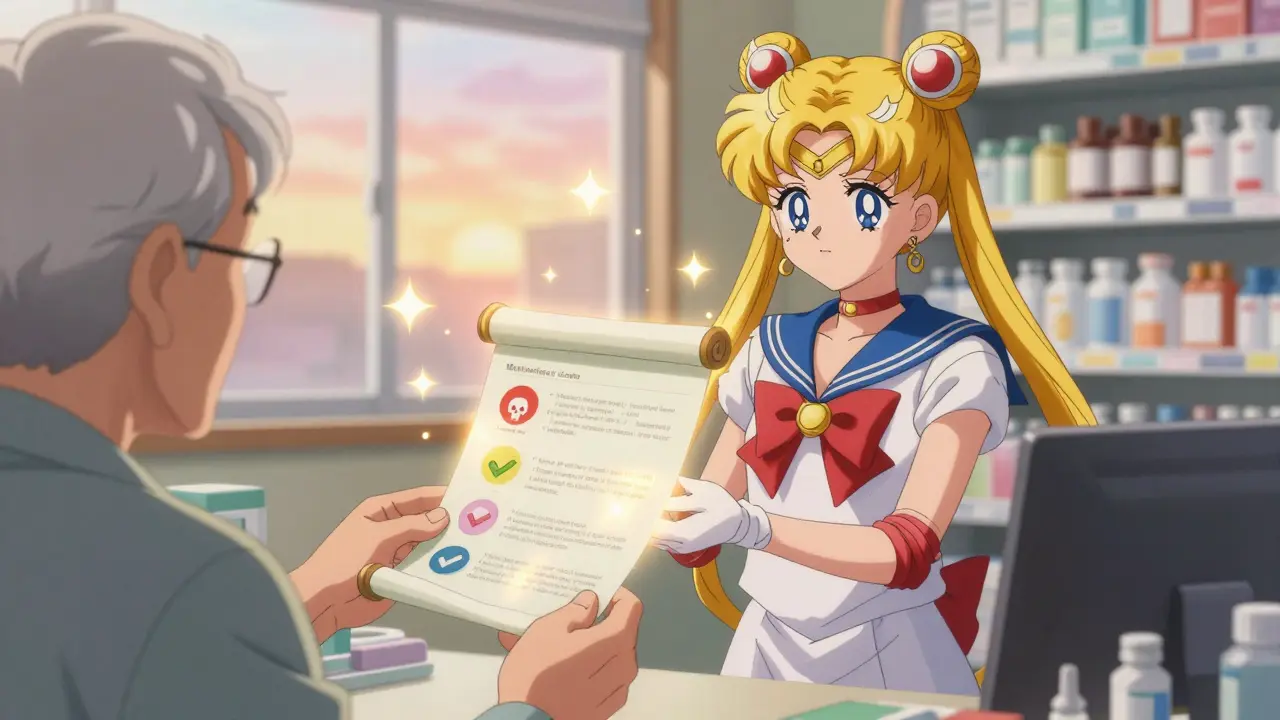
The FDA knows printed guides aren’t perfect. That’s why they’re making changes. Starting in 2024, new guides must include visual risk icons-simple symbols that show how dangerous a side effect is. Think: a red skull for life-threatening, a yellow exclamation for serious, a green check for mild. They’re also rolling out multilingual versions in the top 25 non-English languages spoken in the U.S. And for the first time, electronic versions are allowed. Some pharmacies now offer QR codes that link to video explanations or interactive risk checkers. One drug, Jardiance, already has an interactive guide. Scan the code, answer a few questions about your health, and it gives you a personalized risk summary. That’s the future.Bottom Line: Don’t Ignore It
Medication Guides aren’t paperwork. They’re your first line of defense against serious harm. They’re not perfect-but they’re the only federally required, standardized, and verified safety tool you get with your prescription. If you’re on a high-risk medication, treat this guide like your medical insurance card. Keep it. Read it. Understand it. Ask questions. It’s not just advice. It’s a warning. And sometimes, a warning is the most important thing you’ll ever read.Are Medication Guides required for all prescription drugs?
No. Only about 150 prescription drugs in the U.S. require a Medication Guide, mostly those with serious risks like opioids, certain antidepressants, biologics, and cancer treatments. Most common medications-like antibiotics or blood pressure pills-don’t need one.
Can I get a Medication Guide electronically instead of paper?
Yes. Since 2022, the FDA allows electronic delivery if you request it. Some pharmacies offer QR codes on the printed guide that link to digital versions, or you can sign up for email or app-based delivery. But you still have the right to ask for a printed copy if you prefer.
What should I do if my pharmacist doesn’t give me a Medication Guide?
Ask for it. If they say they’re out of stock, ask them to order one from the manufacturer or call another pharmacy. You have a legal right to receive it with every fill of a drug that requires one. Don’t accept a refill without it.
Are Medication Guides only for adults?
No. They’re for anyone prescribed the medication, including teens and older adults. But if you’re giving the medicine to a child or elderly person, make sure someone who understands it reads the guide with them. Some guides have special sections for caregivers.
Can I throw away the Medication Guide after I finish my prescription?
If you’re done with the medication and won’t need it again, you can dispose of it. But if you might refill it later-or if you’re taking it long-term-keep it. Side effects can appear months or years in. Also, if you switch doctors, the new one will want to see what you’ve been taking.
Do Medication Guides replace talking to my pharmacist?
No. They’re meant to work with, not replace, pharmacist counseling. The guide gives you the facts. Your pharmacist helps you apply them to your life. Always ask questions-even if you’ve read the guide.
Chandreson Chandreas
January 1, 2026 AT 21:36Been reading these guides since my dad had that scary reaction to his chemo med. Honestly? I keep mine taped to the pill bottle with a highlighter on the red flags. 🚨
One time I spotted a warning about dizziness I didn’t even know was a thing - called my doc, turned out my blood pressure was dropping. Saved me from a fall.
These aren’t paperwork. They’re your personal safety net. Don’t ignore ‘em. 😌
Retha Dungga
January 3, 2026 AT 13:37So like… why do they even print these things 🤔
Everyone just throws them out
Why not just make a TikTok video or something
Like ‘5 signs your med is trying to kill you’
😂
Lawver Stanton
January 4, 2026 AT 22:35Okay but let’s be real - these guides are a joke. I’ve got a 12-page pamphlet for a pill that just makes me sleepy. Half of it is just ‘don’t take with grapefruit’ repeated five different ways. The FDA is out here micromanaging my life like I’m a toddler with a butter knife.
And don’t get me started on the ‘sixth-grade reading level’ nonsense. I’ve got a master’s degree and I’m being talked down to like I can’t spell ‘hepatotoxicity’.
Meanwhile, the real issue? Pharmacists don’t even have time to explain the damn thing. They just hand it to you like a receipt from McDonald’s. It’s performative safety. It’s not helping. It’s just noise.
And now they’re adding emojis? A skull for death? Really? Are we trying to make this a children’s book? I’m not scared of a symbol - I’m scared of being misinformed by a system that treats me like a dumb kid who needs cartoons to understand aspirin.
It’s not the guide’s fault - it’s the culture that treats patients like passive recipients instead of partners in care. But nope, let’s just slap a QR code on it and call it innovation.
Meanwhile, my cousin died because she didn’t know her antidepressant could cause serotonin syndrome. No emoji could’ve saved her. No ‘green check’ would’ve made her ask the right question.
So yeah. I read mine. But I also call my doctor. And I don’t trust the system. Not even a little.
Sara Stinnett
January 6, 2026 AT 19:15How utterly predictable. The FDA, that bastion of bureaucratic brilliance, thinks that slapping a six-grade reading level on a life-or-death document somehow makes people safer.
Let me guess - they also think that if you print ‘DON’T TOUCH THE HOT STOVE’ in Comic Sans, children will listen?
These guides are a performative gesture wrapped in regulatory vanity. They exist to absolve manufacturers and pharmacists of liability, not to educate.
And let’s not pretend that ‘visual risk icons’ are innovation - they’re infantilization. A skull? A yellow exclamation? Are we designing a board game or a pharmacopeia?
Meanwhile, the real problem - the systemic failure of patient-provider communication - is left untouched.
People don’t read these because they’re overwhelmed, poorly timed, and delivered by cashiers who’ve been trained to say ‘have a nice day’ while handing you a 300-word warning about sudden cardiac arrest.
Stop treating patients like toddlers and start treating them like humans who deserve context, not clipart.
linda permata sari
January 7, 2026 AT 05:56OMG I just remembered - my abuela in the Philippines got her diabetes med from a cousin who brought it from the US and she didn’t get the guide because the pharmacy there didn’t have it.
She almost had a stroke because she didn’t know the drug could mess with her blood pressure if she ate too much salt.
She’s 78 and speaks only Tagalog.
When I finally got her the translated guide? She cried. Not because she was scared - because someone finally spoke to her like she mattered.
So yes. Multilingual guides? YES. Please. More of this. 🙏
And if you’re reading this and you’re a pharmacist - don’t just hand it out. Sit with them. Translate. Make it real.
Because medicine isn’t just pills. It’s love.
Brandon Boyd
January 7, 2026 AT 12:32Y’all are underestimating these guides. I used to toss ‘em too - until I started tracking my meds with a little notebook and kept the guide taped to it.
Now I bring it to every appointment. My doctor says it’s the first time in 10 years someone showed up with the actual guide in hand.
And guess what? She actually asked me questions about it. We changed my dosage.
It’s not magic. It’s just showing up. Being prepared.
Don’t wait for a crisis to read it. Read it before the first pill.
You’re not just taking a drug - you’re entering a conversation with your body.
And this guide? It’s the first word.
Frank SSS
January 8, 2026 AT 04:01Bro I read the guide for my antidepressant and found out I was supposed to watch for suicidal thoughts - which I’d been having for months and thought were just ‘normal stress’.
Called my doc the next day.
Turned out the med was making it worse.
Switched meds. Life changed.
So yeah. I don’t toss ‘em anymore.
It’s not about being paranoid.
It’s about not being dumb.
And honestly? I’m kinda mad I didn’t read it sooner.
Paul Huppert
January 8, 2026 AT 07:07Just wanted to say - I’ve been keeping my guides in a manila folder labeled ‘My Meds’ since 2019. Every time I refill, I update the date. If I ever get hospitalized, someone can just grab that folder.
It’s not glamorous. But it’s mine.
And I think that’s kind of beautiful.