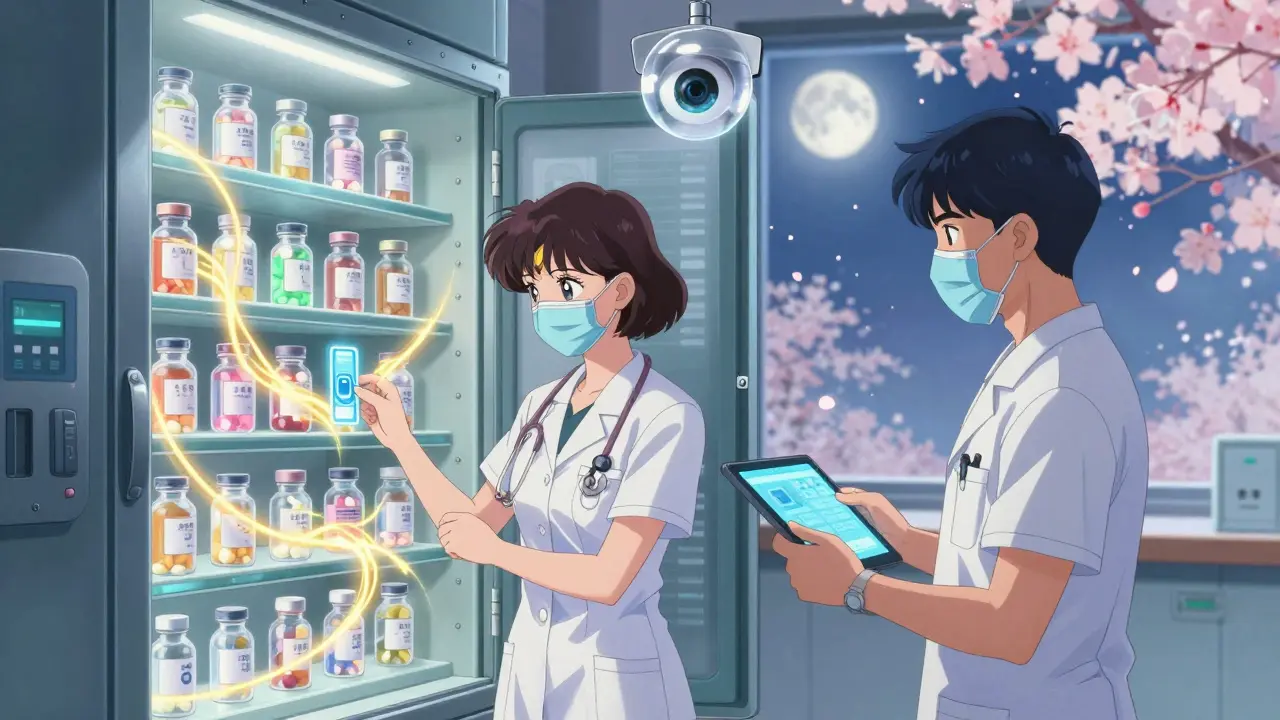
Storing controlled substances isn’t just about locking a cabinet. It’s about stopping someone from taking medication meant for a patient - and potentially saving a life. In 2025, healthcare facilities across the U.S. are under more pressure than ever to secure opioids, sedatives, and other high-risk drugs. The DEA is auditing more often, fines are higher, and patient safety is on the line. If your facility still uses old-school locked cabinets with no logs, you’re not just behind - you’re at risk.
Why Controlled Substance Storage Matters
Every year, an estimated 37,000 incidents of drug diversion happen in U.S. healthcare settings. That’s not just theft - it’s patients getting the wrong dose, staff becoming addicted, and hospitals facing lawsuits. The Controlled Substances Act of 1970 created a closed system: every pill, vial, or patch must be tracked from manufacturer to patient. But tracking only works if storage is tight. The DEA doesn’t just want you to lock things up. They want you to prove you’re doing it right. During inspections, agents check storage areas in 98% of visits. If they find a cabinet without access logs, or a pharmacist who can access the vault alone, you could face a fine of up to $187,500. And if a diverted drug leads to a patient getting infected or harmed? Costs jump to $287,000 per incident.What the Law Actually Requires
The rules come from 21 CFR Part 1301. It’s simple: you must have “effective controls and procedures to guard against theft and diversion.” That’s it. No fancy wording. No loopholes. But what does “effective” mean in practice?- Access must be limited - ideally to one or two people per shift.
- Storage must be secure - not just locked, but monitored.
- Every transaction must be documented - electronically if possible.
- Personal items like bags, purses, or coats must be banned from medication areas.
- Any loss or theft must be reported within one business day.
Manual Storage vs. Automated Systems
Many small clinics still use manual storage: a locked cabinet, a clipboard, and a pharmacist who signs out drugs by hand. It’s cheap. But it’s dangerous. Here’s the data:| Feature | Manual Storage | Automated Dispensing Cabinet (ADC) |
|---|---|---|
| Diversion Risk | 4.2x higher than ADCs | 73% reduction in incidents |
| Access Logs | None or paper-based | Digital, timestamped, user-specific |
| Authentication | Key or combination | Biometric or dual-factor (badge + PIN) |
| Staff Time Required | 37% more for inventory | Automated reconciliation |
| Cost (per unit) | $500-$2,000 | $45,000-$75,000 |
What Smaller Facilities Should Do
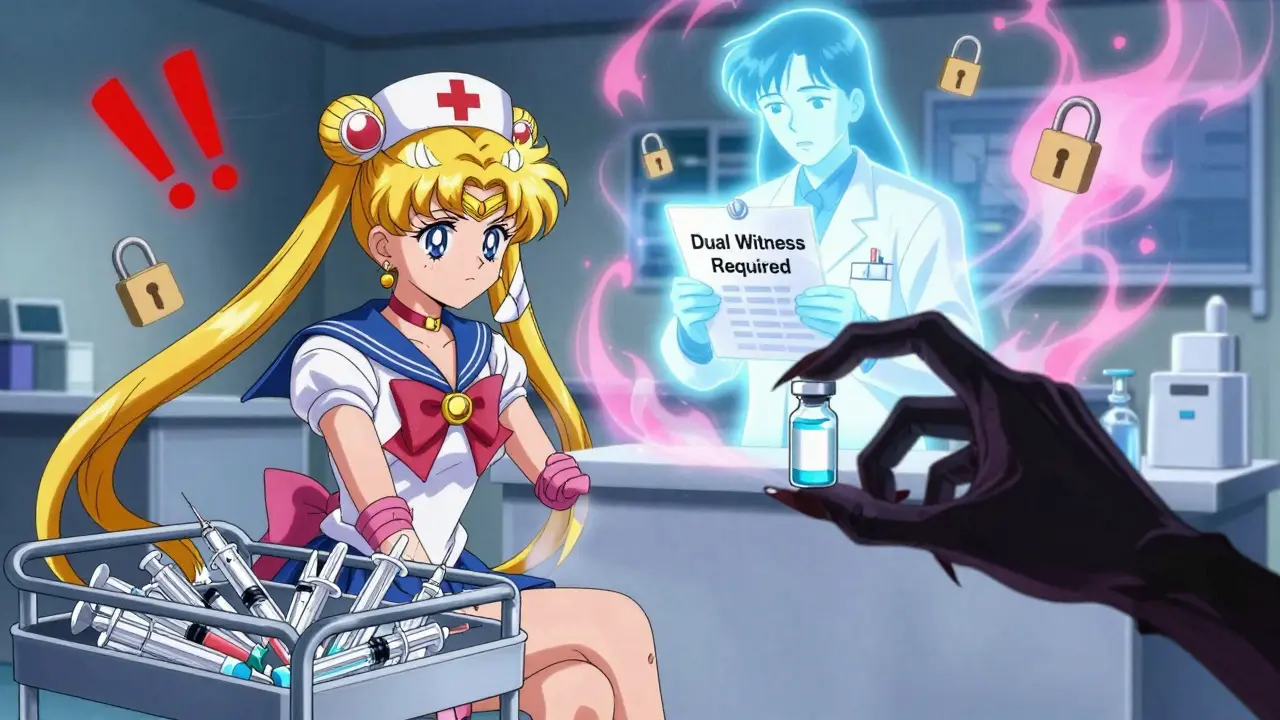
You don’t need an ADC to stay compliant. You need discipline.- Use dual control: Two authorized staff must be present for every access to the controlled substance cabinet. One unlocks. One watches. One logs. One signs.
- Install a camera pointing at the cabinet. Not to spy - to deter. People won’t try to steal if they know they’re being watched.
- Keep the cabinet in a room with no windows, no exits, and no access to non-pharmacy staff.
- Require all staff to store personal bags, coats, and phones in a locker outside the pharmacy area. In 31% of diversion cases, drugs were hidden in purses or pockets.
- Do daily audits. Not weekly. Not monthly. Every single day. Look for missing doses, late returns, or odd patterns - like someone always taking fentanyl right before lunch.
Where Diversion Happens - And How to Stop It
Most people think theft happens in the pharmacy vault. But the real danger is in the handoffs.- Compounding areas: When a nurse prepares a syringe from a vial, there’s no system to track if a drop was siphoned off. Solution: Use pre-filled syringes when possible. If not, require two people to witness the preparation.
- Floor stock: Drugs kept on nursing units for emergencies. These are the most vulnerable. Solution: Only keep the minimum needed. Return unused doses immediately. No “I’ll put it back tomorrow.”
- Waste disposal: Nurses flush drugs down the sink to cover theft. Solution: Use secure disposal units with dual locks. Require witness signatures for every disposal. And never, ever let someone dispose of drugs alone.
- Return to pharmacy: A vial returned with “a little left.” That’s a red flag. Solution: Require exact counts. If a vial says 10mL and returns with 8.5mL, investigate. It’s not a spill - it’s a diversion.

Training and Culture Matter More Than You Think
You can have the best cabinets in the world, but if your staff thinks “it’s not a big deal” or “everyone does it,” you’re still at risk. In a 2022 survey, 63% of healthcare workers resisted new storage rules. But after six months of consistent training, 89% said they felt safer and more aware. Here’s what works:- Run mandatory training every six months. Not a 10-minute PowerPoint. A real session with real cases.
- Share anonymized stories: “Last month, a nurse took 3 doses of hydromorphone. We caught it because the system flagged a pattern. She got help. We saved her.”
- Make reporting easy. No blame. Just support. Create a hotline or anonymous form.
- Recognize staff who catch errors. A thank-you note, a coffee gift card - it builds culture.
What’s Coming in 2026
The rules are tightening. By 2026, expect:- AI-powered systems that flag anomalies - like someone accessing fentanyl at 3 a.m. three days in a row.
- Integration with electronic health records so every drug given is automatically matched to a patient order.
- More states requiring real-time reporting to state prescription drug monitoring programs (PDMPs).
- DEA inspections focusing on disposal logs and waste records - not just storage.
Final Checklist: Are You Secure?
Use this every quarter:- Are controlled substances stored in a locked, access-controlled area?
- Is access limited to two or fewer people per shift?
- Are personal bags, coats, and phones banned from medication areas?
- Are all transactions logged - digitally, not on paper?
- Are daily audits done by a pharmacist?
- Are disposal procedures witnessed and signed?
- Has staff been trained in the last six months?
- Is there a clear, anonymous way to report concerns?
Storing controlled substances isn’t about compliance. It’s about care. Every pill you secure is one less chance someone gets hurt - whether it’s a patient, a nurse, or a family member who never knew the truth.
What happens if a controlled substance is stolen?
You must report the theft or significant loss to the DEA within one business day. Failure to do so can result in fines, loss of your DEA registration, and criminal charges. The DEA will conduct an onsite inspection, review your storage logs, and may shut down your controlled substance operations until you fix the gaps. You may also be required to notify affected patients and offer testing for bloodborne pathogens if the drug was injected.
Can a nurse take a controlled substance for personal use if they document it?
No. Even if a nurse documents taking a drug for themselves, it’s still diversion - and illegal. Controlled substances are for patients only. Any use by staff, even for pain or anxiety, violates federal law and hospital policy. Most facilities have substance use programs to help staff get treatment, but they must be reported and handled through those channels - never through the pharmacy.
Are automated dispensing cabinets worth the cost for small clinics?
For clinics under 100 beds, ADCs can be cost-prohibitive. But you don’t need one. Instead, focus on dual control, camera surveillance, daily audits, and banning personal bags. These low-cost steps can reduce diversion risk by up to 89%. If your clinic grows, plan to upgrade to an ADC within 2-3 years. Many vendors offer leasing options to ease the financial burden.
What’s the biggest mistake facilities make with storage?
Assuming that locking a cabinet is enough. The biggest risk isn’t the vault - it’s the handoffs. When a drug moves from pharmacy to floor stock, or from a vial to a syringe, that’s when diversion happens. If you’re not watching those moments with two sets of eyes and digital logs, you’re leaving the door open.
How often should controlled substance inventories be counted?
Daily. Every single day. A pharmacist or designated staff member must reconcile all controlled substances - from the vault to the ADCs to floor stock - before the end of each shift. This isn’t optional. It’s the single most effective way to catch theft early. Waiting a week or a month means you’re already too late.
Can I use a regular lockbox from a hardware store?
No. The DEA requires storage that meets “effective controls” standards - meaning it must be tamper-resistant, access-controlled, and ideally, logged. A hardware store lockbox has no audit trail, no user identification, and no way to prove who accessed it. Use a DEA-compliant cabinet or a secure pharmacy-grade safe with digital logs. Anything less is a liability.
Bobbi-Marie Nova
January 17, 2026 AT 14:35Okay but let’s be real - if your facility still uses a clipboard for controlled substances, you’re one coffee break away from a Netflix documentary.
My cousin’s a nurse in Ohio and they just installed a camera over the cabinet. Within two weeks, someone tried to sneak a fentanyl vial into their purse. Camera caught it. HR called. She got help. No jail. Just rehab.
Locks aren’t enough. Surveillance isn’t spying. It’s saving lives.
Also, why is everyone still using paper logs in 2025? Are we in a time warp?
Allen Davidson
January 18, 2026 AT 04:25I’ve worked in 3 different hospitals and the ones with ADCs were night and day safer. But here’s the truth - the real problem isn’t the tech, it’s the culture.
At my last job, we had dual control, cameras, digital logs - but the head nurse would say ‘just this once’ when someone asked for extra morphine.
That’s the crack in the dam.
Training isn’t a checkbox. It’s a daily conversation. If your staff thinks ‘it’s not a big deal’ - you’re already losing.
Fix the culture first. The tech follows.
john Mccoskey
January 19, 2026 AT 19:09Let’s analyze this from a systems theory perspective. The Controlled Substances Act of 1970 was predicated on a Cartesian model of linear accountability - individual actors, discrete transactions, static responsibility. But modern healthcare is a complex adaptive system. You cannot manage emergent behaviors - like diversion - with rigid, top-down controls.
Automated dispensing cabinets introduce a new layer of algorithmic surveillance, which, while statistically effective, creates a false sense of security. The human element remains the variable that cannot be quantified - the nurse who takes a dose because her child is sick and she can’t afford the co-pay.
Compliance is not safety. Safety is empathy. The DEA wants logs. But what about the log of human suffering that leads to the theft?
Until we address the socioeconomic drivers of diversion, we are merely rearranging deck chairs on the Titanic.
Ryan Hutchison
January 21, 2026 AT 08:31Let’s cut through the BS. This isn’t about ‘culture’ or ‘empathy’ - it’s about America being soft on crime.
Every single one of these cases? Someone broke the law. Period.
We don’t need more ‘training’ or ‘anonymous hotlines.’ We need mandatory drug testing for all pharmacy staff. Random, no-notice, zero tolerance.
If you’re stealing meds, you’re not a victim - you’re a criminal.
And if your facility can’t handle that, you don’t deserve to handle opioids.
Stop coddling. Start punishing. That’s how you stop this.
Melodie Lesesne
January 21, 2026 AT 22:17My clinic’s got a locked cabinet, two keys, and a camera. We don’t have an ADC, but we do daily audits and no bags allowed.
It’s not perfect, but it’s working.
One thing that helped? Putting a little sign above the cabinet: ‘We’re watching. Not to punish - to protect.’
People get it. It’s not about suspicion. It’s about care.
Also, the coffee gift cards for catching errors? Total game changer. Everyone’s looking out for each other now.
Corey Sawchuk
January 23, 2026 AT 11:36Been in this game 18 years
Manual logs were fine when we had 30 patients a day
Now we got 200 and 4 nurses stealing from the same cabinet
Camera fixed half the problem
Dual control fixed the rest
But the real win? When the new grad nurse caught her own preceptor taking a vial
She didn’t say anything till shift ended
Just handed the log to the pharmacist
Quiet hero
That’s the culture we need
Not tech
Not fines
Just people who care enough to speak up
Rob Deneke
January 24, 2026 AT 04:34Small clinic here - 75 beds, no ADC, budget is tight
But we did the dual control thing and banned all bags
Also started doing daily counts at 7am before shift starts
Guess what? Diversion dropped 80% in 3 months
Turns out people don’t steal when they know someone’s watching and counting
And yes it takes 15 extra minutes a day
But that’s cheaper than a lawsuit
And way cheaper than losing a nurse to addiction
Simple stuff works
Stop overcomplicating it
Chelsea Harton
January 24, 2026 AT 13:28the DEA doesnt care about your budget
they care about logs
if you cant prove you tracked it
you guilty
no excuses
paper logs = death sentence
get digital or get out
Jody Fahrenkrug
January 26, 2026 AT 09:08My mom’s a nurse in a rural ER. She told me they used to keep the opioids in a drawer with a padlock.
One night, a guy came in with chest pain. They gave him morphine. He coded. Turned out the last dose was gone before he even got there.
Turns out the night nurse was taking it for her back pain.
She got fired. Went to rehab. Still works at the clinic now - as a patient advocate.
They put a camera up after that.
Not to punish.
To remember.
Every pill matters.
kanchan tiwari
January 27, 2026 AT 01:54THIS IS A GOVERNMENT PLOT.
They want you to buy expensive cabinets so they can sell you the software.
They’re also tracking your every move through the cameras.
Soon they’ll be scanning your retina every time you open the drawer.
And the ‘anonymous hotline’? It’s not anonymous. It’s a spy network.
They’re setting up a national database to monitor ALL healthcare workers.
They’re afraid of nurses.
They know we’re the real power.
Don’t fall for it.
Use a lockbox.
Write on paper.
And pray.
They can’t control what they can’t track.