
Taking a blood thinner is often a life-saving necessity, but it can feel like a minefield when you start adding other prescriptions or over-the-counter pills to the mix. If you are using DOAC interactions, you've probably noticed that your doctor doesn't ask you to get your blood tested every week like they do for people on warfarin. While that freedom is great, it can create a false sense of security. The reality is that your body's ability to clear these drugs depends on specific proteins and enzymes that other medications can either speed up or shut down.
When these pathways are blocked or overstimulated, the amount of anticoagulant in your blood can swing too high-leading to dangerous bleeding-or too low, leaving you vulnerable to a stroke or blood clot. Because most people on these medications are managing several health issues at once, the risk of "polypharmacy" (taking five or more meds) is incredibly high. Understanding how these drugs collide is the best way to stay safe.
Key Takeaways for Patients and Caregivers
- DOACs generally have fewer food interactions than warfarin, but drug-drug interactions are still a major risk.
- The most critical "collision points" are the P-gp transporter and the CYP3A4 enzyme.
- Common meds like certain heart rhythm drugs or NSAIDs can either increase bleeding risk or make the blood thinner less effective.
- Kidney function is a huge factor; if your kidneys are struggling, interactions become even more dangerous.
- Always disclose herbal supplements, as they often affect the same metabolic pathways as prescription drugs.
What Exactly Are DOACs?
Before looking at the interactions, we need to define what we are dealing with. Direct Oral Anticoagulants is a class of medications designed to prevent blood clots by targeting specific clotting factors in the blood. Commonly referred to as DOACs, these include drugs like apixaban, rivaroxaban, dabigatran, and edoxaban. Unlike older medications like warfarin, which require constant monitoring of the INR (International Normalized Ratio), DOACs provide a more predictable response and act much faster.
The "Traffic Jams": How Interactions Happen
To understand why some drugs clash, think of your body as having a series of security checkpoints and disposal chutes. Two main systems handle DOACs:
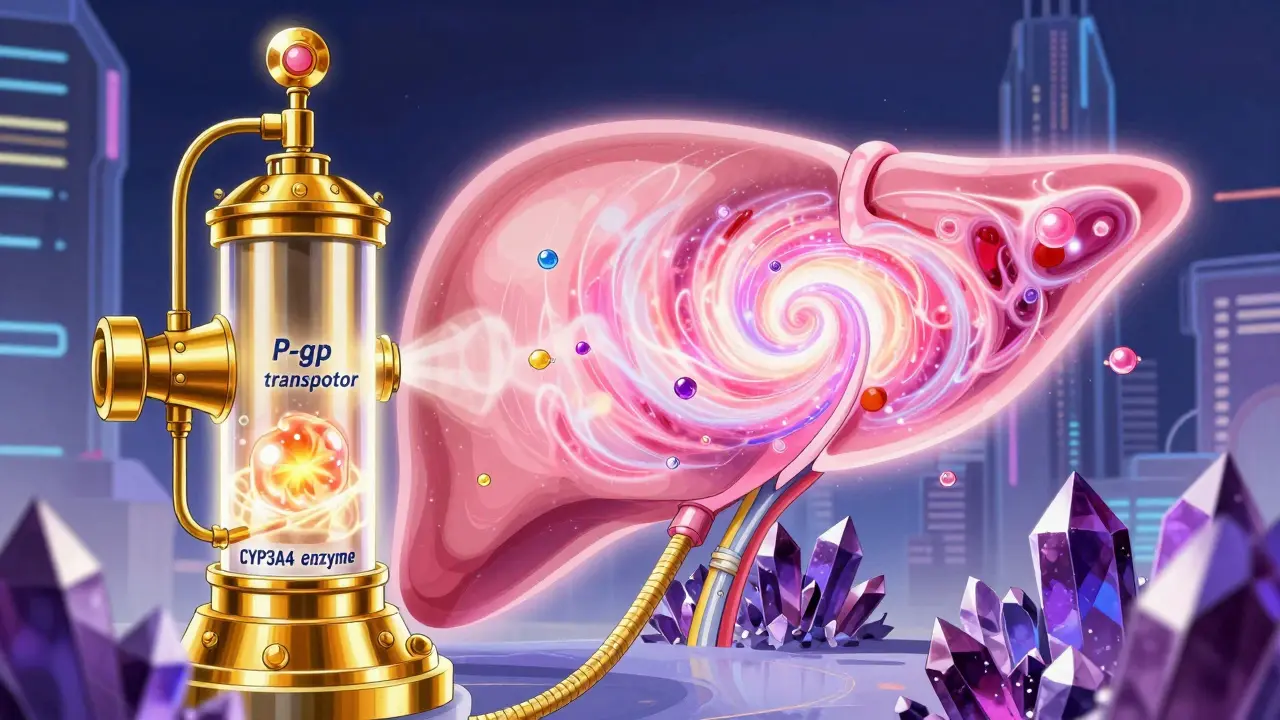
First, there is the P-gp transporter (P-glycoprotein). This acts like a pump that pushes medication out of your cells and back into the gut or kidneys for removal. If another drug "clogs" this pump, the DOAC stays in your system longer, increasing the risk of bleeding.
Second, there is the CYP3A4 enzyme, a powerhouse in the liver that breaks down many medications. apixaban and rivaroxaban rely heavily on this enzyme to be cleared from the body. If a drug inhibits this enzyme, the blood thinner builds up. Conversely, if a drug "induces" (speeds up) this enzyme, the blood thinner is cleared too quickly, which could lead to a thrombotic event (a clot).
| Medication | P-gp Dependence | CYP3A4 Dependence | Primary Risk |
|---|---|---|---|
| Apixaban | High | Moderate (20-25%) | Combined inhibition |
| Rivaroxaban | High | High (50%) | Strong CYP3A4 inducers |
| Dabigatran | High | None | P-gp pump blockers |
| Edoxaban | High | Low/None | P-gp transporter issues |
Dangerous Combinations to Watch For
Not all interactions are created equal. Some are mild, while others require an immediate change in dosage or a different medication entirely. Here are the most common culprits:
Heart and Rhythm Medications
Drugs used to treat arrhythmias often interfere with the P-gp pump. For instance, amiodarone is a moderate P-gp inhibitor. When taken with a DOAC, it can lead to higher concentrations of the blood thinner. More seriously, dronedarone strongly inhibits P-gp and moderately inhibits CYP3A4. In many cases, using dronedarone with dabigatran or rivaroxaban should be avoided entirely. If you're on edoxaban, your doctor might need to drop your dose to 30 mg once daily to compensate.
Blood Pressure and Heart Rate Control
Calcium channel blockers like verapamil and diltiazem can also cause issues. Verapamil, for example, inhibits P-gp, which can bump up the levels of dabigatran. In some patients, this requires reducing the dabigatran dose to 110 mg twice daily. Interestingly, this specific interaction is usually less concerning for those taking apixaban or rivaroxaban.
The "Additive Effect": When Plasma Levels Don't Change
Some of the most dangerous interactions aren't about how the drug is processed, but how it works in the blood. These are called pharmacodynamic interactions. NSAIDs (Non-Steroidal Anti-Inflammatory Drugs) like ibuprofen or naproxen don't necessarily change the amount of DOAC in your blood, but they irritate the stomach lining and affect platelet function. Combining these with a blood thinner is like poking a hole in a dam while increasing the water pressure-the risk of a major GI bleed skyrockets.
Similarly, SSRIs (Selective Serotonin Reuptake Inhibitors) used for depression can interfere with how platelets clump together. While they don't change the "concentration" of the DOAC, the combined effect makes it harder for your body to stop a bleed if an injury occurs.
The Kidney Factor: A Hidden Variable
Your kidneys are the primary exit ramp for most DOACs. If you have chronic kidney disease or age-related renal decline, your body already struggles to clear these medications. When you add a drug that inhibits P-gp or CYP3A4 on top of impaired kidney function, you create a "perfect storm." The medication builds up far more rapidly than it would in a healthy adult, which is why renal function tests are critical before starting and during the maintenance of DOAC therapy.

Practical Steps for Staying Safe
Managing these interactions doesn't mean you have to stop necessary treatments. It means being proactive. If you are prescribed a new medication, ask your pharmacist these three specific questions:
- Does this drug affect the P-gp transporter or the CYP3A4 enzyme?
- Will this increase my risk of stomach bleeding, even if it doesn't change my blood thinner levels?
- Do I need a dose adjustment for my blood thinner based on my latest kidney function tests?
Be wary of "natural" supplements. Many herbal products act as strong inducers or inhibitors. For example, some supplements can speed up the CYP3A4 enzyme, effectively "washing" the blood thinner out of your system and leaving you unprotected against clots. Always treat your supplement bottle with the same caution as a prescription pill.
Are DOACs safer than warfarin regarding interactions?
Generally, yes. DOACs have far fewer interactions with common foods (like leafy greens) and a wider range of medications compared to warfarin. However, they are not "interaction-free." The risks are just different-centered more on P-gp and CYP3A4 pathways rather than vitamin K interference.
Can I take Advil or Aleve while on a DOAC?
You should be very cautious. NSAIDs like ibuprofen (Advil) and naproxen (Aleve) increase the risk of gastrointestinal bleeding and can interfere with platelet function. Most doctors recommend acetaminophen (Tylenol) for pain relief instead, as it doesn't carry the same bleeding risk.
What are the signs that an interaction is causing a problem?
If the DOAC level is too high, watch for unusual bruising, nosebleeds that won't stop, or blood in the stool (which may look like black tar). If the level is too low, the signs are more subtle until a clot occurs, such as sudden shortness of breath, chest pain, or unilateral leg swelling.
Does my dose change if I start a new heart medication?
It depends on the drug. For example, starting dronedarone may require a dose reduction for edoxaban. Your physician will determine if a dose adjustment is needed based on the specific DOAC you are taking and the potency of the interacting drug.
Do I need regular blood tests while on DOACs?
Unlike warfarin, DOACs do not require routine INR monitoring. However, you still need regular blood tests to check your kidney and liver function, as these organs determine how the drug is cleared from your body.
Next Steps and Troubleshooting
If you've just been prescribed a new medication: List every single drug and supplement you take and hand it to your pharmacist. They have the best tools to spot "invisible" interactions between P-gp and CYP3A4 inhibitors.
If you notice a sudden increase in bruising: Do not stop taking your blood thinner abruptly. This can trigger a rebound clotting effect. Instead, contact your healthcare provider immediately to check if a recent medication change has increased your anticoagulant levels.
If you are planning a surgery: Even minor procedures can be risky with DOACs. Because these drugs have a short half-life, your doctor will give you a specific window of time to stop the medication before the procedure to ensure you don't bleed excessively during surgery.
Sam Hayes
April 4, 2026 AT 14:23just a quick tip here for everyone... make sure you actually bring a physical list of your meds to the pharmacy because the computer systems dont always talk to each other and it is the easiest way to catch these p-gp issues before they happen
Rachelle Z
April 6, 2026 AT 00:54Oh wow... just wow!!! 🙄 I just love how we are expected to be our own pharmacists now... because clearly that is a great system for everyone involved!!! 💊✨ Absolutely thrilling!!!
Branden Prunica
April 7, 2026 AT 18:13I literally almost had a heart attack reading about the GI bleed risk! I took an ibuprofen yesterday and now I am spiraling! This is actually terrifying! Why is nobody talking about how scary this is?!
Vicki Marinker
April 9, 2026 AT 03:44The assumption that patients have the cognitive bandwidth to track CYP3A4 enzymes is laughable. This guide is far too optimistic about the average person's health literacy.
Aysha Hind
April 10, 2026 AT 10:01Typical big pharma nonsense, hiding the real dangers behind fancy terms like "polypharmacy." They want us dependent on a cocktail of chemicals that clash like thunder while they profit off the "corrective" meds they sell us to fix the problems the first pill caused! It is a predatory cycle and this guide is just a shiny brochure for the machine!
Beth LeCours
April 10, 2026 AT 20:30too long didnt read
Lawrence Rimmer
April 12, 2026 AT 17:55We spend our lives trying to manage the flow of our own blood, which is the ultimate irony of existence. We are essentially just plumbing projects with an ego, fighting a losing battle against our own chemistry while pretending we have control over the inevitable decay of our organs.
angel sharma
April 14, 2026 AT 12:07This is such an incredible resource for everyone to read because knowledge is the absolute greatest power we have in the fight for our own health and if we all just take a moment to be proactive and communicate with our doctors we can truly optimize our wellbeing and live long vibrant lives full of energy and strength!
Hudson Nascimento Santos
April 14, 2026 AT 17:04It is interesting to consider the balance between the predictability of DOACs and the manual control of warfarin. One offers freedom, the other offers visibility. The trade-off is essentially trust in the system versus trust in the test.
Dipankar Das
April 15, 2026 AT 03:11You must realize that negligence in monitoring your renal function is absolutely unacceptable! It is your duty as a patient to demand these tests immediately if you are on a DOAC! Do not let a lazy physician overlook your kidney health or you will suffer the consequences!