When a brand-name drug hits the market, it doesn’t stay alone for long. But how long does it actually get to enjoy exclusive sales before generics show up? That depends entirely on where you are. In the U.S., the rules are a maze of patents, extensions, and legal loopholes. In the EU, it’s more structured but still layered. And in places like Brazil or China, the rules are changing fast - often to the frustration of patients waiting for cheaper options.
How Long Do Patents Last? The Global Baseline
At its core, every country follows the same starting point: a 20-year patent from the date of filing. That’s not a coincidence. It’s required under the TRIPS Agreement, the global trade rule that came into force in 1995. But here’s the catch: drug development takes years. By the time a drug gets approved by regulators, most of that 20 years are already gone.
On average, innovators only get 6 to 10 years of real market exclusivity after approval. That’s not enough to recoup the $2.3 billion it typically costs to bring a new drug to market, according to Tufts Center for the Study of Drug Development. So countries built extra layers on top of patents - and that’s where things get messy.
The U.S. System: A Patchwork of Protections
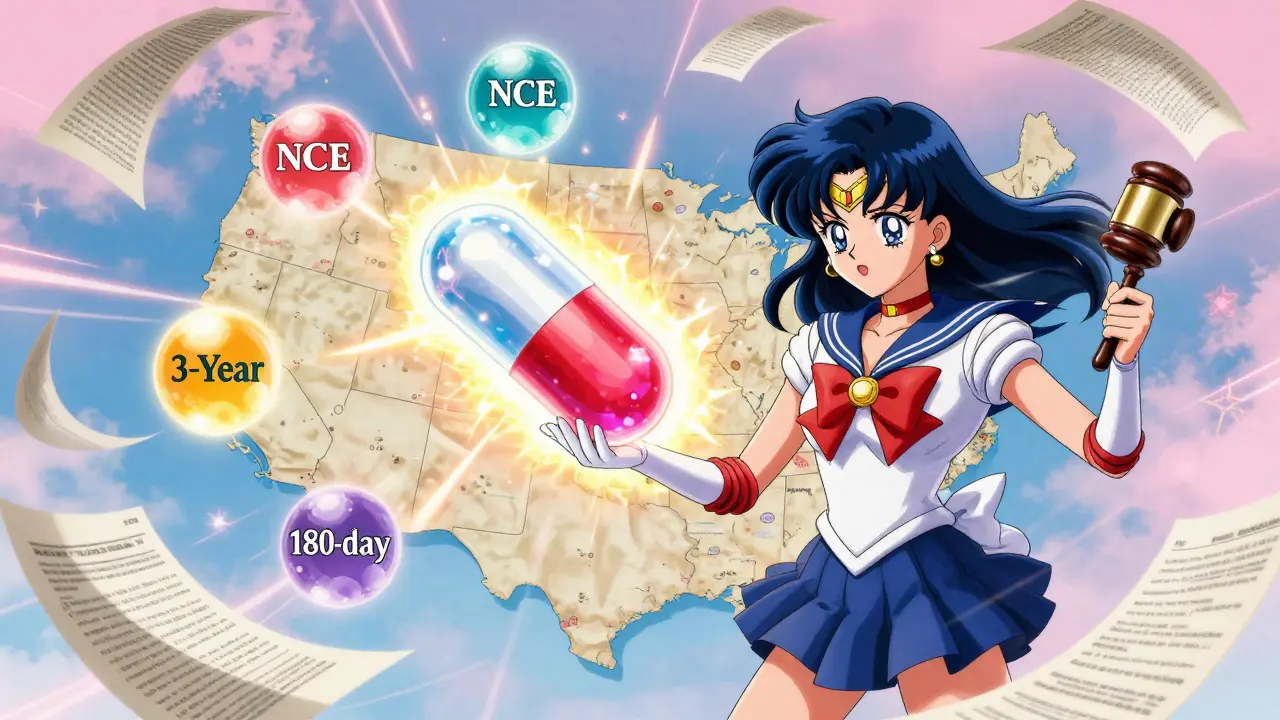
The U.S. uses the Hatch-Waxman Act of 1984 as its foundation. It’s designed to balance innovation and access, but in practice, it’s become a battleground. The system has five main types of exclusivity:
- New Chemical Entity (NCE) exclusivity: 5 years. No generic can even file an application during this time.
- Orphan Drug Exclusivity: 7 years for drugs treating rare diseases (fewer than 200,000 patients in the U.S.).
- 3-year exclusivity: For new clinical studies that aren’t just about safety or dosage - think new uses or formulations.
- Patent Term Extension (PTE): Up to 5 extra years, but the total time from approval can’t exceed 14 years.
- 180-day exclusivity: The golden ticket. The first generic company to successfully challenge a patent gets to be the only generic on the market for six months.
This last one - the 180-day window - is what makes the U.S. system so volatile. It’s meant to reward risk-takers. But it’s also been exploited. Brand companies sometimes pay generics to delay entry. These “pay-for-delay” deals were ruled anti-competitive in FTC v. Actavis (2013), but they still happen. In 2023, 78% of U.S. pharmacists reported seeing delays in generic availability because of these settlements.
And then there’s the Orange Book. It’s the FDA’s official list of patents linked to brand drugs. On average, a single drug has 142 patents listed there. That’s not a typo. Teva’s CEO said in 2023 that navigating this patent thicket costs millions per product - and even then, 42% of generic applications fail because of legal missteps.
The EU: The 8+2+1 Rule
Europe doesn’t have a 180-day race. Instead, it uses a fixed timeline called the 8+2+1 system:
- 8 years of data exclusivity: Generic companies can’t use the brand’s clinical trial data to get approval.
- 2 years of market exclusivity: Even if a generic gets approved, it can’t be sold yet.
- 1-year extension: If the brand company adds a new, significant indication during the first 8 years, they get an extra year.
This system is simpler than the U.S.’s, but it’s also slower. Generic companies can’t even start the approval process until after 6 years. And unlike the U.S., there’s no legal shortcut - no Paragraph IV challenges. That means fewer generics enter the market early, and when they do, it’s usually after the full 10+ years.
Supplementary Protection Certificates (SPCs) can add up to 5 more years, but the total protection - patent plus SPC - can’t exceed 15 years from the date of first marketing authorization. That’s tighter than the U.S. system, which sometimes stretches to 14 years post-approval plus patent extensions.

Other Major Markets: Canada, Japan, China, Brazil
Canada’s rules are close to the EU’s: 8 years of data protection, 2 years of market exclusivity. It’s predictable, but not aggressive.
Japan offers 8 years of data exclusivity and 4 years of market exclusivity - longer than the EU’s market protection period. The Japanese regulatory agency, PMDA, announced in late 2023 it’s planning to simplify its patent linkage system to speed up generic entry.
China made a major shift in 2020, extending data exclusivity from 6 to 12 years. That move was aimed at encouraging innovation, but it’s also delayed access to affordable drugs for millions.
Brazil followed suit in 2021 with Medida Provisória 1.040, setting 10 years of data exclusivity. That’s longer than the U.S. and EU combined in some cases. Critics say it protects profits over patients - especially for HIV and hepatitis C drugs.
Why This Matters: The Real-World Impact
By 2028, $356 billion in global branded drug sales will face patent expiration. That’s not just a number - it’s millions of prescriptions. When generics enter, prices drop 80-90% within a year, according to IQVIA.
But access isn’t equal. In high-income countries, drugs become generic after about 12.7 years on average. In low-income countries? It takes 19.3 years. Why? Because trade deals like CETA and others force developing nations to adopt data exclusivity rules they can’t afford. Ellen ‘t Hoen, a leading access-to-medicines expert, says these clauses block generics even after patents expire - a quiet tax on poor patients.
And then there’s the innovation argument. Merck says its drug Keytruda’s effective exclusivity was extended from 8.2 to 12.7 years through patent stacking. PhRMA argues that without this protection, drug development would collapse. But Harvard’s Dr. Aaron Kesselheim says the average drug now has 38 extra patents - many on tiny changes like a new pill coating or a slightly different salt form. That’s not innovation. That’s legal padding.
What’s Changing? The Future of Generic Entry
Pressure is mounting. The U.S. is debating the Preserve Access to Affordable Generics and Biosimilars Act, which would make pay-for-delay deals illegal by default. The EU is proposing to cut data exclusivity to 5 years for some drugs, while keeping stronger protections for truly novel medicines.
McKinsey predicts that by 2027, patent extensions will make up 45% of total exclusivity - up from 32% in 2020. That means even more time before generics appear. Meanwhile, generic manufacturers are getting smarter. Companies like Mylan didn’t just challenge patents - they redesigned the delivery system to avoid infringement entirely.
But the biggest challenge isn’t legal. It’s strategic. Generic companies need teams of lawyers, regulatory experts, and chemists just to get one drug approved. The average cost to launch a generic after a patent challenge? $2-5 million. That’s why only the biggest players can compete - and why 65% of the U.S. generic market is controlled by the top 10 companies.
Who Wins? Who Loses?
Patients in wealthy countries get cheaper drugs sooner - but often after long delays caused by legal games. Patients in poor countries wait years longer, if they get access at all. Generic manufacturers win big when they break through - but the cost of entry is crushing for small firms. Brand companies profit from extended exclusivity, but they’re also investing less in truly new drugs - instead, they’re chasing patents on old ones.
The system was meant to balance innovation and access. Today, it leans hard toward protection. And while the pharmaceutical industry claims it’s essential, the data shows something else: most of the money goes to legal teams, not labs.
The question isn’t whether patents matter. Of course they do. But how long is too long? And who gets to decide?
How long does patent protection last for generic drugs in the U.S.?
The base patent lasts 20 years from the filing date, but because drug development takes 10-12 years, most drugs only have 6-10 years of market exclusivity after approval. The U.S. allows Patent Term Extension (PTE) of up to 5 years, but the total time from approval can’t exceed 14 years. Combined with other exclusivities like NCE (5 years) or orphan drug (7 years), effective protection can stretch to 12-14 years or more.
What is the difference between patent and data exclusivity?
A patent protects the chemical formula or method of making a drug - it’s a property right. Data exclusivity protects the clinical trial data submitted to regulators. Even if a patent expires, generic companies can’t use the brand’s data to get approval during the data exclusivity period. In the U.S., data exclusivity is part of the 5-year NCE period. In the EU, it’s an 8-year block separate from patents.
Why do generic drugs take longer to launch in developing countries?
Many developing countries are pressured by trade agreements to adopt strict data exclusivity rules - even when patents have expired. For example, HIV drugs in South Africa were delayed by up to 11 years because of EU trade deals. These rules prevent generic manufacturers from using existing trial data to get approval, forcing them to run expensive new studies they can’t afford.
What is the 180-day exclusivity period in the U.S.?
It’s a reward for the first generic company to successfully challenge a brand drug’s patent through a Paragraph IV certification. That company gets 180 days of exclusive sales before any other generic can enter. But it’s often delayed by “pay-for-delay” deals, where the brand pays the generic to hold off. The FTC has fought these deals, but they still happen.
Can a drug have both a patent and data exclusivity?
Yes, and they often do. In the U.S., a new chemical entity gets 5 years of data exclusivity, and it may also have patents that last longer. In the EU, the 8-year data exclusivity runs alongside patent protection. These protections can stack - meaning a drug might be protected for 12 years or more even after its patent expires.
Are there efforts to shorten exclusivity periods?
Yes. The EU is proposing to reduce data exclusivity to 5 years for some drugs. The U.S. Congress is considering bills to ban pay-for-delay deals. The WHO recommends rebalancing exclusivity to match actual R&D costs, not corporate profits. But powerful industry lobbying keeps most changes slow or watered down.
Peter Sharplin
January 25, 2026 AT 04:28The U.S. system is a mess. I work in pharma compliance and I’ve seen firsthand how companies stack patents on trivial changes-like switching from a tablet to a capsule-to extend exclusivity. It’s not innovation, it’s legal gymnastics. The Orange Book isn’t a reference guide, it’s a weapon. And the 180-day window? More like a lottery where only the biggest players can afford to play.
shivam utkresth
January 25, 2026 AT 11:00India’s generics saved millions during the HIV crisis, but now we’re being squeezed by trade deals that force us to copy the U.S. system. Data exclusivity? We don’t have the infrastructure to run new trials. Why should a kid in rural Bihar wait 12 years for a drug that’s been around since 2005? The patent isn’t the problem-it’s the power grab disguised as protection.
John Wippler
January 27, 2026 AT 10:22Let’s be real-pharma isn’t in the business of saving lives. It’s in the business of maximizing shareholder value. The $2.3 billion cost to develop a drug? That includes marketing, lobbying, and legal teams. The actual R&D? Maybe $300 million. The rest is profit engineering. We treat drug development like it’s rocket science, but it’s really just finance with a lab coat. And the public pays the bill while the innovators cash in on loopholes.
Harvard’s Kesselheim is right. Most patents now aren’t about breakthroughs-they’re about coating a pill differently. That’s not innovation. That’s exploitation dressed up as progress.
And don’t get me started on the EU’s 8+2+1. It sounds fair, but it’s just slower. Patients don’t care about legal elegance. They care about whether they can afford their meds next month.
Aurelie L.
January 28, 2026 AT 23:03So what? Let them patent everything. If you can’t afford your meds, that’s your problem.
Ashley Porter
January 29, 2026 AT 05:33Patent thickets are a real thing. I’ve reviewed Orange Book listings for 12 different drugs. One had 217 patents. Not 217 unique inventions. 217 filings on minor variations-salt forms, dissolution rates, packaging. It’s not protection. It’s obstruction. And the FDA’s system doesn’t even flag this. They just accept the list.
Kipper Pickens
January 30, 2026 AT 10:46China’s move to 12 years of data exclusivity is a wake-up call. They’re not trying to be fair-they’re trying to become the next U.S. pharma hub. And guess what? It’s working. More global R&D is shifting there now. But the cost? Millions of patients in Africa and Southeast Asia get locked out. This isn’t just policy. It’s global inequality with a patent number.
rasna saha
January 31, 2026 AT 02:49I’ve seen patients cry because they couldn’t get their insulin. Not because it was unavailable-but because the generic was blocked by a patent extension no one understood. We talk about innovation like it’s sacred. But when your kid needs a drug and the price is still $800 a month after 15 years? That’s not innovation. That’s cruelty.
Skye Kooyman
February 1, 2026 AT 07:24the 180 day thing is wild
Joanna Domżalska
February 3, 2026 AT 04:14Everyone’s mad about drug prices but nobody wants to pay more taxes to fund R&D. The system works fine. You just don’t like losing.