
Imagine this: you land in Tokyo after a long flight, excited to start your vacation. You grab your carry-on, head to customs, and pull out your pill organizer filled with your daily meds. The officer asks for proof. You don’t have the original bottles. Suddenly, your meds are confiscated. Your anxiety medication? Gone. Your blood pressure pills? Held. You’re stuck - no access, no replacement, no easy fix.
This isn’t a rare scenario. It happens more often than you think. And the reason? Carrying medications in original containers isn’t just a good idea - it’s often the difference between a smooth trip and a travel nightmare.
The Transportation Security Administration (TSA) in the U.S. doesn’t technically require your pills to be in their original prescription bottles. But here’s the catch: while federal security rules are relaxed, state laws, international customs, and airline policies are not. If you skip the original container, you’re gambling with your health - and your trip.
Why Original Containers Matter More Than You Think
Let’s clear up the biggest myth: TSA doesn’t demand original bottles. That’s true. But that doesn’t mean you should ignore them. The real issue isn’t security screening - it’s what happens after you land.
In 37 U.S. states, including California, New York, and Texas, it’s illegal to transport prescription medications outside their original labeled containers. Even if you’re just driving across state lines, you could face fines or legal trouble. And if you’re flying internationally? The rules get even stricter.
Take Japan. Pseudoephedrine (found in Sudafed) is banned. Codeine? Illegal without a special permit. Adderall and Ritalin? Completely prohibited in countries like Singapore, UAE, and South Korea. If you’re caught with these in a pill organizer - even if they’re yours - you could be arrested.
Original containers aren’t just for show. They include the pharmacy label with your name, the drug’s generic and brand name, dosage, prescribing doctor, and expiration date. That’s the proof customs officers need. Without it, they have no way to verify your meds are legal and safe.
What the TSA Actually Allows
TSA lets you bring any amount of solid medication in your carry-on. No limits. No need to declare it - unless you’re carrying liquids.
Liquid medications (like insulin, cough syrups, or liquid antibiotics) can exceed the standard 3.4-ounce limit. But you must tell the TSA officer at the start of screening. Don’t wait for them to ask. Say it upfront: “I have medically necessary liquids.”
And never, ever pack meds in checked luggage. Bags get lost. Bags get cold. Bags get delayed. Medications like insulin, epinephrine pens, or thyroid pills can degrade or freeze. United Airlines and the International Air Transport Association both warn that over 17% of medications in checked bags experience temperature extremes that ruin their effectiveness.
Ice packs? Allowed. But you have to declare them too. Same with refrigerated meds. If you’re bringing a cooler with frozen gel packs, tell the officer. They’ll screen it - but they won’t take it away if you explain it’s for medicine.
International Rules Are a Minefield
Traveling outside the U.S.? You’re entering a patchwork of 187 different country rules. The U.S. Department of State keeps a list - and it’s growing.
Here are real examples:
- Thailand: Codeine and tramadol require a special permit. Without it, you’re breaking the law.
- United Kingdom: You can only bring a 30-day supply of most prescription drugs. More than that? You need prior approval.
- Germany: Benzodiazepines (like Xanax) require a doctor’s note and must be in original packaging.
- Mexico: Adderall is banned. Even with a U.S. prescription, you can’t bring it in.
The U.S. Embassy in Mexico found that travelers who carried meds in original containers with doctor’s letters had a 68% lower chance of being denied entry. That’s not a small edge - that’s a life-changing advantage.
And it’s not just about legality. The International Association for Medical Assistance to Travelers studied 1,247 travelers. Those with original containers experienced 73% fewer delays at customs. No questions. No confiscations. Just a quick nod and on your way.
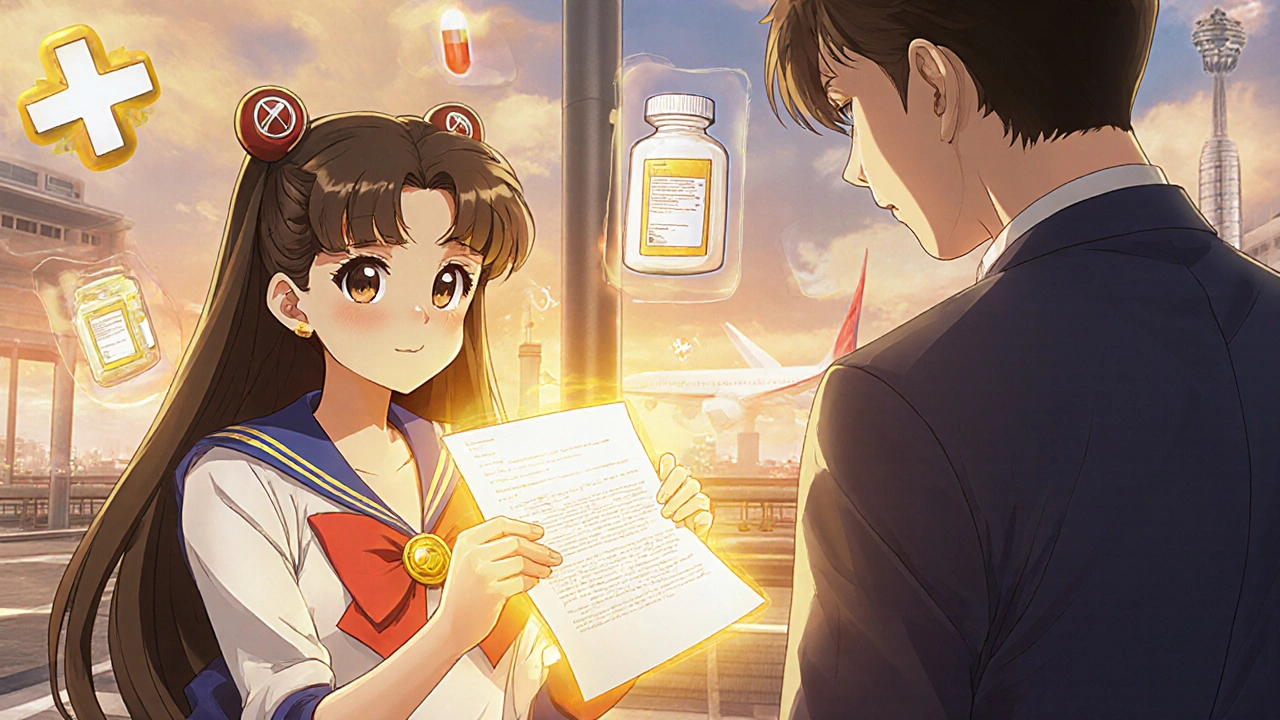
What to Do If You Can’t Keep Pills in Original Bottles
Some people - especially those on multiple medications - find original bottles bulky. That’s fair. But you can’t just dump them into a plastic pill case and hope for the best.
If you must use a pill organizer:
- Label every compartment with the drug name, dose, and frequency - clearly and permanently.
- Carry a printed copy of your prescription or a doctor’s letter on official letterhead.
- Include your doctor’s license number, phone number, and the generic name of each drug.
- Take a photo of each original bottle and save it on your phone. It’s not official, but it’s better than nothing.
Pro tip: Print two copies of the letter. Keep one in your carry-on, one in your wallet. If one gets lost, you still have backup.
How Much Should You Bring?
Always bring more than you think you’ll need. Delays happen. Flights get canceled. You might get sick and need extra doses.
Experts recommend bringing at least 10-15% extra - and for international trips, aim for 20-30% extra. Why? Because the medication you rely on may not be available overseas - or it might be counterfeit.
The FDA found that 11.7% of medications bought abroad are fake or substandard. In Southeast Asia, that number jumps to 28.4%. You can’t risk running out and having to buy something off a street vendor.
Also, check if your insurance covers refills overseas. Most don’t. So plan ahead. Talk to your pharmacist before you leave. Ask: “Can you split my prescription into smaller bottles for travel?” Many pharmacies will do this for free.
Temperature-Sensitive Medications
Insulin, epinephrine, certain antibiotics, and biologics need to stay cool. Heat and freezing can destroy them.
Here’s what works:
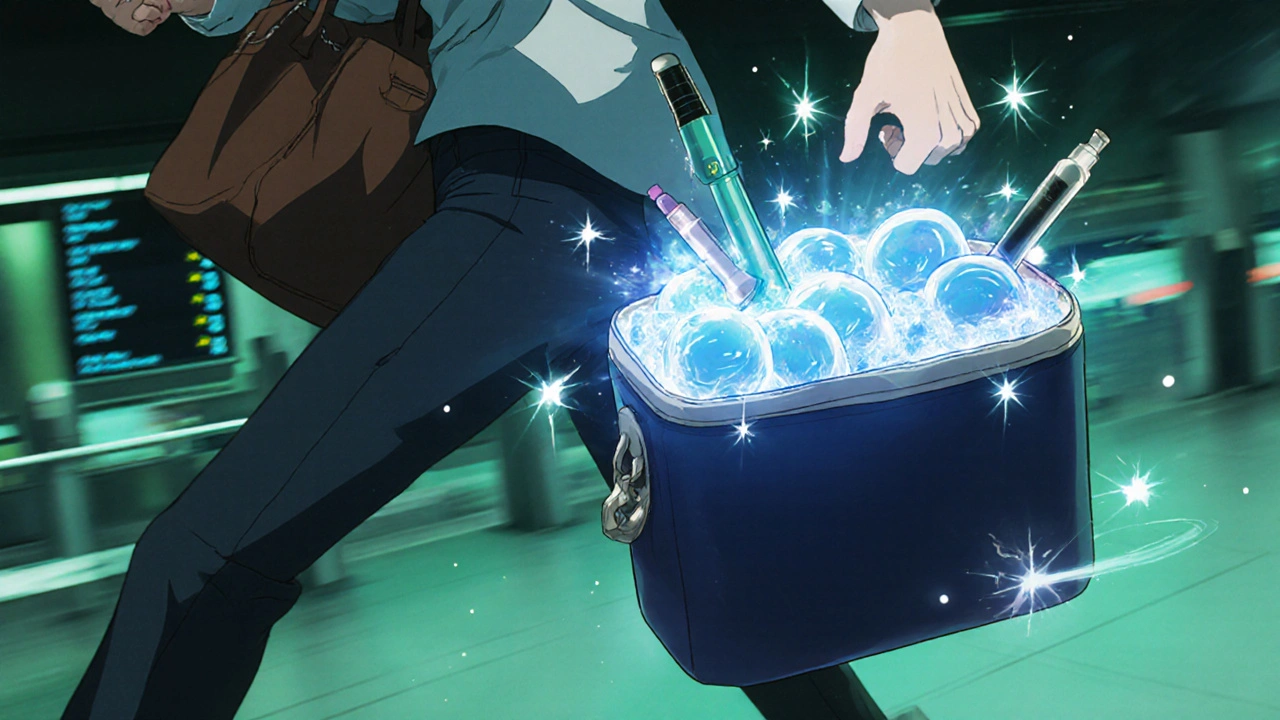
- Use a small insulated travel cooler with reusable ice packs.
- Keep it in your carry-on. Never check it.
- Declare the ice packs at security. They’re allowed, but you must say so.
- Ask your pharmacist for temperature-stable alternatives if available.
According to the Cleveland Clinic, 23% of travelers in 2023 had meds that degraded during flights because they weren’t stored properly. That’s not just inconvenient - it’s dangerous.
Doctor’s Letter: Your Secret Weapon
A doctor’s letter isn’t optional for international travel - it’s essential.
Here’s what it should include:
- Your full name and date of birth
- List of all medications (generic and brand names)
- Dosage and frequency
- Reason for use (e.g., “treatment for hypertension”)
- Doctor’s name, license number, phone number, and clinic address
- Letterhead and signature
Print it. Sign it. Carry it. Don’t rely on your phone. Customs officers don’t always have Wi-Fi. Paper is still king.
Studies show travelers with this letter had screening times 42% faster. That’s over 5 minutes saved per checkpoint. Multiply that by three security stops on a long trip - that’s 15 minutes you won’t waste.
What to Do If Your Meds Get Confiscated
If your meds are taken:
- Stay calm. Arguing won’t help.
- Ask for a written receipt. It’s your proof you had them.
- Contact your embassy immediately. They can help you find local pharmacies or arrange replacements.
- Call your doctor back home. They may be able to fax a new prescription to a local pharmacy.
Don’t wait. Act fast. Many countries have emergency supply programs for travelers with chronic conditions.
Final Checklist Before You Fly
- ✔ All meds in original containers with labels intact
- ✔ Doctor’s letter printed and signed
- ✔ Extra meds (10-30% more than needed)
- ✔ Liquid meds declared at security
- ✔ Ice packs declared if used
- ✔ Meds in carry-on - never checked baggage
- ✔ Photos of original bottles saved on phone
- ✔ Research destination country’s drug laws
Traveling with medication isn’t about being overly cautious. It’s about being prepared. The rules aren’t always fair. But they’re real. And if you skip the basics, you’re putting your health at risk.
Keep your meds in their original bottles. Bring the letter. Pack extra. And never check your bag. It’s not complicated. It’s just common sense - and it could save your trip.
Do I have to keep my pills in original bottles when flying within the U.S.?
TSA doesn’t require it, but 37 U.S. states have laws that do. Even if you’re not flying internationally, keeping meds in original containers protects you from legal issues during state-level checks, like at rental car counters or hotel front desks. It’s the safest, simplest rule to follow.
Can I bring my insulin in a travel cooler?
Yes. Insulin and other temperature-sensitive meds can be carried in a small insulated cooler with ice packs. You must declare the cooler and ice packs to TSA at the start of screening. Never check it - checked baggage can freeze or overheat, ruining your medication.
What if my medication is banned in my destination country?
Don’t bring it. Countries like Japan, Singapore, and the UAE ban common U.S. meds like Adderall, codeine, and pseudoephedrine. Even with a prescription, you can be arrested. Talk to your doctor before you travel - they may be able to prescribe a legal alternative. Never assume your U.S. prescription is valid overseas.
Can I use a pill organizer for travel?
You can, but only if you also carry a doctor’s letter and a printed prescription. Label every compartment clearly. Take photos of the original bottles. Pill organizers are convenient, but they’re not legal proof. Without documentation, you risk having your meds seized.
Do I need to declare my medications at airport security?
Only if you’re carrying liquids over 3.4 ounces. Say it clearly at the start of screening: “I have medically necessary liquids.” For pills, no declaration is needed. But if you’re using a pill organizer, be ready to explain what’s inside if asked.
What if I need to refill my prescription while traveling?
It’s often impossible. Many countries won’t fill a U.S. prescription. Even if they can, the medication might be different or counterfeit. Always bring enough for your entire trip - plus extra. Talk to your pharmacist before you leave about getting a larger supply or a travel-sized prescription.
Nicole M
November 14, 2025 AT 04:03I once had my anxiety meds confiscated in Japan because I used a pill organizer. No warning. No mercy. Just a cold "sorry, illegal." Now I carry every pill in its original bottle, even the stupid ones. No more stress.
Arpita Shukla
November 15, 2025 AT 20:56Actually, the U.S. doesn't have a federal law requiring original containers, but state laws vary wildly. California Penal Code 11350 requires labeling, Texas Health & Safety Code 481.114 too. Even if TSA doesn't care, local cops do. And in India, you need a special permit for any psychotropic, even if it's prescribed. Don't assume your script works globally.
Benjamin Stöffler
November 16, 2025 AT 18:16Let’s be clear: the original container isn’t about bureaucracy-it’s about epistemology. The label is the only objective, verifiable, third-party artifact that bridges the gap between personal autonomy and state sovereignty over pharmacological substances. Without it, you’re not carrying medicine-you’re carrying suspicion. And in a world where algorithms flag anomalies, your pill organizer is a red flag written in lowercase.
Mark Rutkowski
November 17, 2025 AT 01:21Traveling with meds isn’t about following rules-it’s about honoring your body’s needs in a world that doesn’t always get it. I’ve had insulin freeze in checked baggage, and let me tell you, nothing makes you feel more powerless than watching your lifeline turn to slush. Keep it in your carry-on. Bring the letter. Bring the extra. You’re not being paranoid-you’re being responsible. And that’s worth more than any TSA shortcut.
Ryan Everhart
November 17, 2025 AT 09:54So let me get this straight-you’re telling me I can’t trust a pill organizer but I can trust a doctor’s letter that could be printed on a napkin? 🤔 I mean, sure, the bottle has a label… but so does my cereal box. Who’s really verifying any of this?
David Barry
November 18, 2025 AT 08:1017% of meds in checked bags experience temp extremes? That’s not a statistic-it’s a failure of logistics. Airlines treat meds like luggage, not life support. And yet, you’re expected to jump through 12 hoops just to carry insulin? The system’s broken. You don’t need a doctor’s letter-you need a lawyer.
Alyssa Lopez
November 19, 2025 AT 07:46USA rules are the only ones that matter. If you're going to some third-world country that bans Adderall, that's THEIR problem. You're an American citizen-carry your meds like you're supposed to. TSA says it's fine, so it's fine. Stop overcomplicating this. Also, typo in the post: 'medications' is spelled wrong twice.
Alex Ramos
November 20, 2025 AT 02:22Pro tip: I keep a small ziplock with all my original bottles + a printed copy of my Rx + a photo of each bottle on my phone. Also, I always say "I have medically necessary liquids" before they even ask. Saves 10 minutes every time. And yes, I use emojis sometimes 😊💊✈️
edgar popa
November 21, 2025 AT 14:38Just bring extra. Always. I once got stuck in Cancun for 3 days because my flight got canceled. Had my extra pills. Didn’t panic. Life hack: ask your pharmacy for travel-sized bottles. They’ll do it for free.
Eve Miller
November 23, 2025 AT 01:37It’s not "common sense." It’s basic compliance. If you can’t be bothered to keep your medication in its legally mandated container, then you deserve to have it taken. This isn’t about inconvenience-it’s about accountability. And if you’re too lazy to print a doctor’s letter, then you’re not a responsible traveler-you’re a liability.
Chrisna Bronkhorst
November 24, 2025 AT 01:09Let’s be real-most customs officers don’t care unless you look sketchy. I’ve flown with pill organizers for years. Never had an issue. But if you’re carrying 20 different pills in a box with no labels? Yeah, you’re asking for trouble. Label it. Bring a copy. Done.
Amie Wilde
November 25, 2025 AT 01:50I use a pill organizer and just carry my Rx on my phone. Never had a problem. But I also don’t fly to Singapore. Know your risks. Simple.
Gary Hattis
November 25, 2025 AT 02:09As someone who’s lived in 7 countries, I’ve seen how wildly drug laws differ. In South Africa, you need a permit for tramadol. In Germany, Xanax needs a notarized note. The U.S. acts like its rules are global-but they’re not. Research. Talk to embassies. Don’t wing it. Your life depends on it. And hey-if you’re worried about bulk? Ask your pharmacist to split your script into smaller bottles. They’ve done it for me every time.