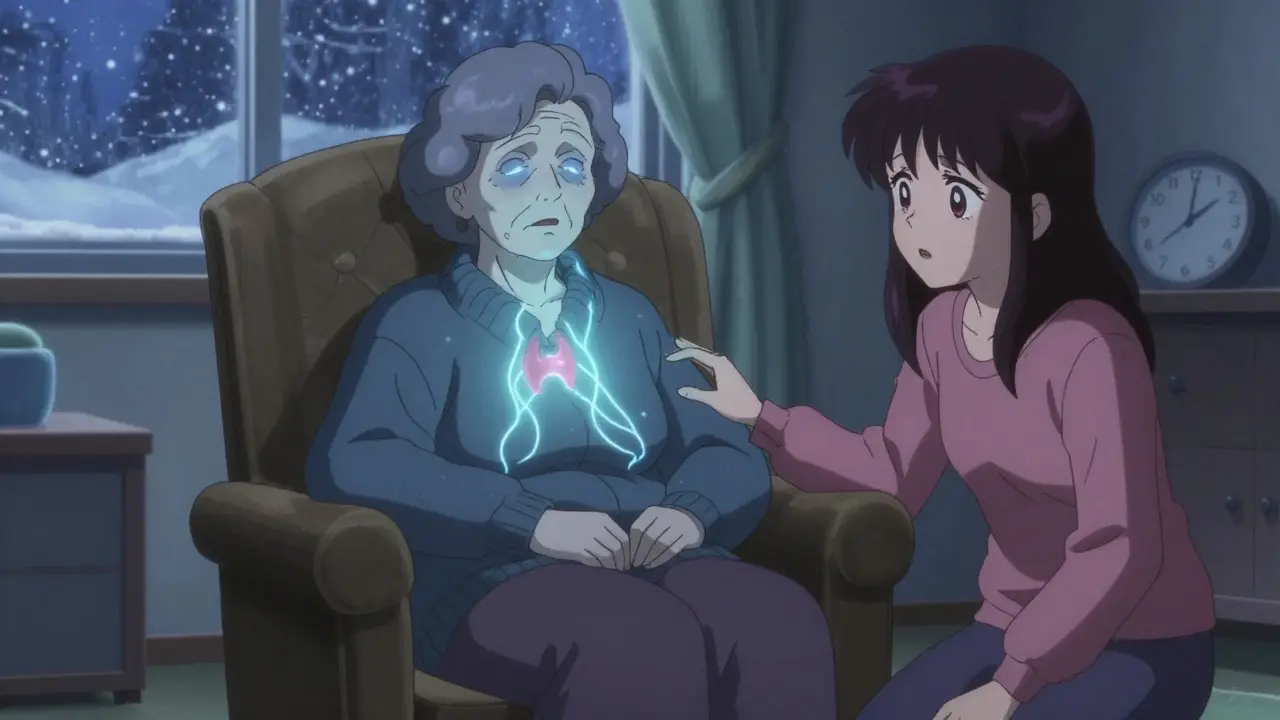
When your body runs out of thyroid hormone, it doesn’t just slow down-it shuts down. Myxedema coma, once thought of as a rare condition only seen in patients lying unconscious in a hospital bed, is now understood as a life-threatening crisis that can strike anyone with untreated or poorly managed hypothyroidism. It doesn’t always begin with coma. Sometimes it starts with confusion, cold skin, or a heart rate so slow it’s hard to feel. And if you wait for lab results before acting, you might already be too late.
What Really Happens in Myxedema Coma?
Myxedema coma isn’t just a drop in thyroid hormone levels. It’s the collapse of multiple systems. Your body’s thermostat fails. Your lungs stop responding to low oxygen. Your heart can’t pump hard enough. Your kidneys can’t hold onto sodium. And your brain? It starts to fog over-not from stress, not from aging, but because your cells are starving for energy.
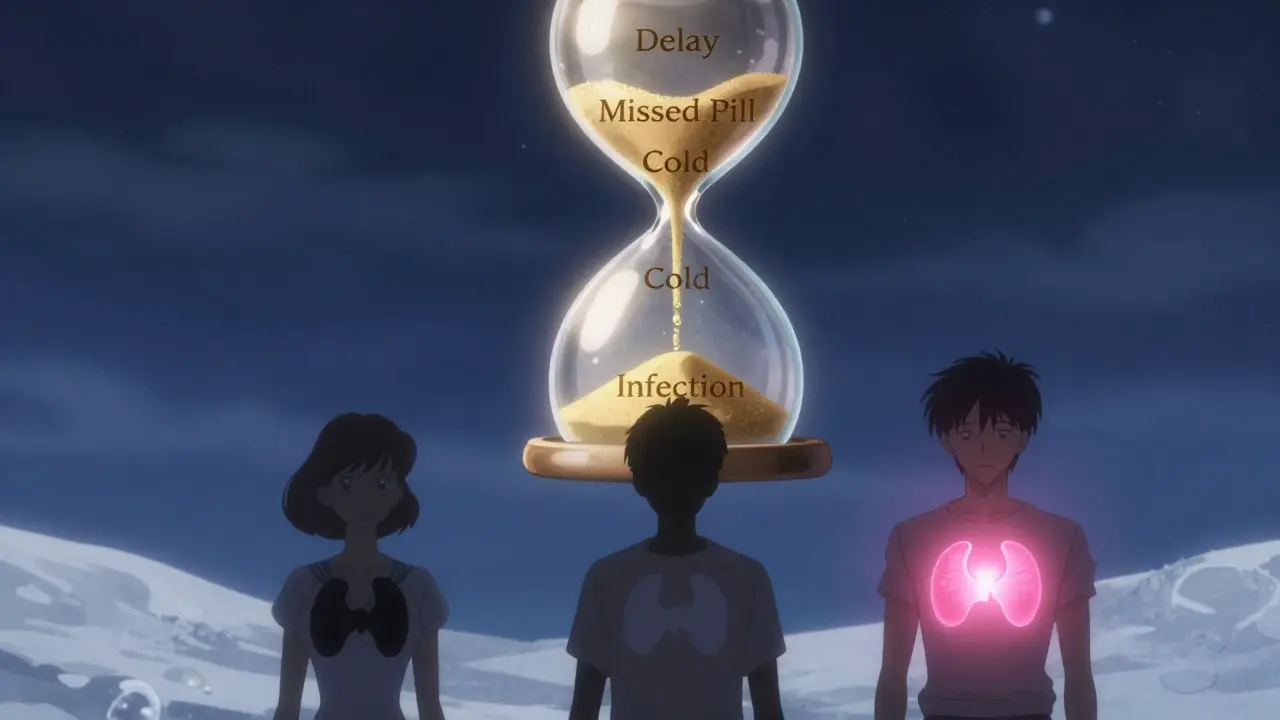
This isn’t a gradual decline. It’s a cascade. One small trigger-a cold night, a missed pill, a urinary infection-can push someone with years of undiagnosed hypothyroidism over the edge. The American Family Physician reports that 98% of cases involve extreme lethargy. Eighty to ninety percent have a core temperature below 35°C (95°F). Over 70% have dangerously low sodium. And in nearly half, breathing slows to fewer than 12 breaths per minute.
Women over 60 are most at risk-three times more likely than men. But men don’t escape unscathed. In fact, men often wait longer for diagnosis because their symptoms get dismissed as "just getting older." A 2023 Healthline survey found that men accounted for 40% of diagnostic delays, even though they make up only 25% of cases.
The Signs You Can’t Afford to Miss
Forget the textbook image of a comatose patient. Real cases look different. A 72-year-old woman is found sitting in her chair, unresponsive, wearing three sweaters in a 22°C room. Her daughter says she’s been "just tired" for months. Her pulse is 48 beats per minute. Her skin is dry, puffy around the eyes. She hasn’t had a bowel movement in a week. Her blood test shows sodium at 128 mmol/L. She’s not depressed. She’s not demented. She’s in myxedema crisis.
The diagnostic triad is simple: altered mental status, hypothermia, and a precipitating event. But the details matter. Mental status isn’t always coma. It could be confusion, slurred speech, or just not answering questions. Hypothermia doesn’t mean freezing. It means your body can’t warm itself anymore-even with blankets. And the precipitating event? Often something small: pneumonia, a UTI, stopping thyroid meds during a hospital stay, or even just being outside too long in winter.
Respiratory failure is silent until it’s too late. Carbon dioxide builds up because the brain stops telling the lungs to breathe. Oxygen drops. The body goes into a low-energy survival mode. That’s why many patients are found with shallow, irregular breathing. No snoring. No gasping. Just stillness.
Why Time Is the Enemy
Every hour of delay increases the chance of death by 10%. That’s not a guess. It’s from NCBI data published in 2023. The average time from symptom onset to treatment is 6 to 12 hours. But in hospitals with clear protocols, that drops to under 2 hours-and survival rates jump.
Why the delay? Because the symptoms mimic so many other things. Depression. Dementia. Stroke. Drug overdose. Even sepsis. In elderly patients, classic signs like weight gain, dry skin, or constipation are often absent. Instead, you get "apathetic hypothyroidism"-a quiet, withdrawn, cold patient who doesn’t complain. Doctors miss it. Families think they’re just tired.
Dr. Robert H. Eckel, former president of the American Heart Association, put it bluntly: "Treatment must not wait for laboratory confirmation." You don’t need a TSH level of 120 mIU/L to start. You need to suspect it-and act.
Emergency Protocol: What to Do Right Now
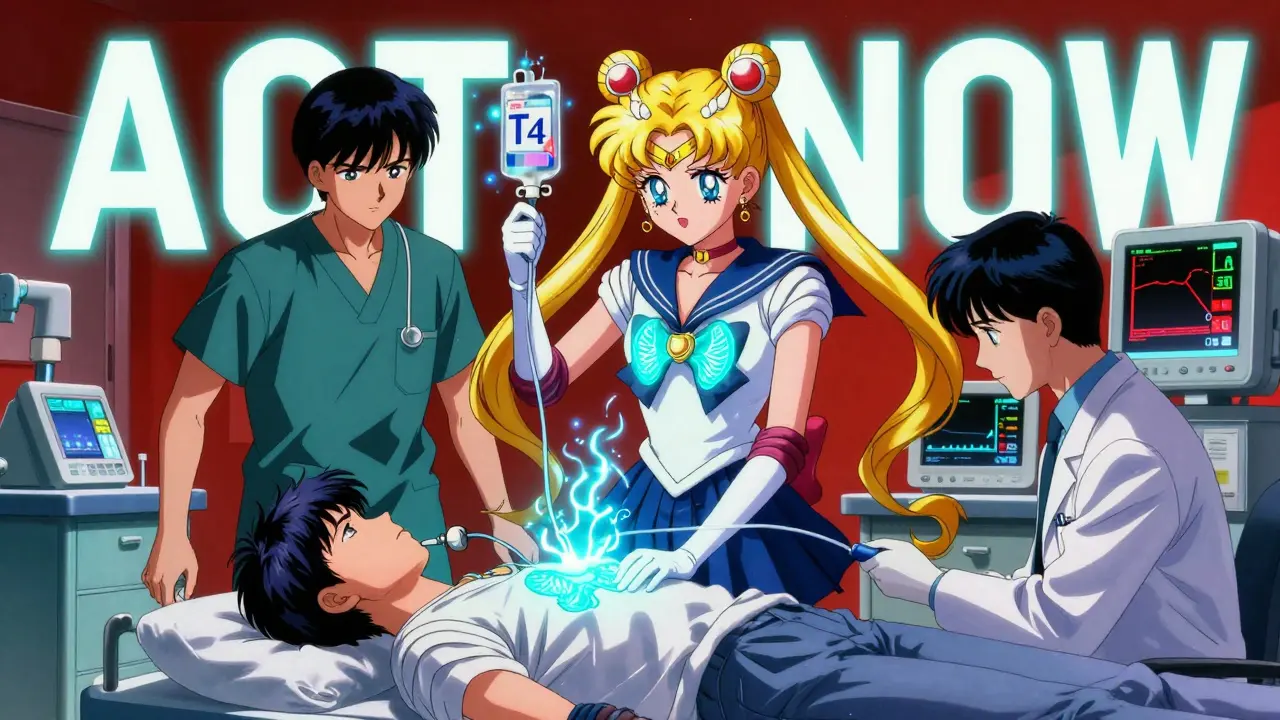
There’s no time for debate. If you suspect myxedema coma, start treatment before the lab report comes back. The steps are clear:
- Secure the airway. Over half of these patients need intubation. Their breathing is too weak. Don’t wait for oxygen levels to crash. If they’re unresponsive and breathing shallowly-intubate.
- Give thyroid hormone immediately. Start with 300-500 mcg of intravenous levothyroxine (T4). If the patient is in cardiac distress, add 10-20 mcg of liothyronine (T3) every 8 hours. The 2022 Endocrine Society update confirmed T3 improves survival in severe cases.
- Warm slowly. No heating blankets. No warm IV fluids. Passive rewarming only. Cover with blankets. Monitor core temperature every 30 minutes. Aggressive rewarming before hormone levels rise can cause heart failure.
- Treat the trigger. Infection is the cause in 30-50% of cases. Start broad-spectrum antibiotics immediately. Don’t wait for cultures. Pneumonia, UTIs, and sepsis are the usual suspects.
- Correct sodium carefully. Hyponatremia is common, but correcting it too fast can destroy brain cells. Limit sodium correction to 4-6 mmol/L in the first 24 hours. Use fluids with caution.
The DIMES mnemonic helps remember triggers: Drugs, Infection, Myocardial infarction/CVA, Exposure to cold, Stroke. Check for each one-quickly.
What Not to Do
There are traps everywhere. One big mistake? Waiting for thyroid tests. Results take hours. By then, it’s too late. Another? Giving glucose too early. Many patients have low cortisol too. If you give sugar without checking cortisol levels, you can trigger adrenal crisis.
Don’t assume they’re just "sleepy." A patient who doesn’t respond to pain or voice isn’t being lazy-they’re dying. Don’t dismiss coldness as "just being sensitive." In myxedema, the body can’t generate heat anymore.
And never, ever use active warming. Hot water bottles, heating pads, warm IV fluids-they sound logical. But they force the body to burn more energy before the thyroid hormone is in the system. That can crash the heart.
Real Stories Behind the Numbers
A 68-year-old woman in Wisconsin stopped her levothyroxine during a hospital stay for pneumonia. Three days later, she was found curled up on her kitchen floor, unresponsive. Her temperature was 31°C. Her TSH was 240 mIU/L. She spent 11 days in the ICU. She recovered-but her daughter says, "We almost lost her because no one thought it could be her thyroid."
A man in his 50s in Auckland went to his GP three times with "brain fog" and fatigue. Each time, he was told to "get more sleep." He stopped taking his meds during a stressful period. Three weeks later, he was found unconscious in his car. His T4 was undetectable. He survived-but had to relearn how to walk.
These aren’t rare. A 2022 survey of 427 hypothyroid patients found 18% had experienced a near-miss event. The top three triggers? Hospitalizations (47%), infections (32%), and cold exposure (28%).
What’s Changing in 2026
The FDA approved a new IV thyroid hormone formulation called Thyrogen® in January 2023. It absorbs faster, which matters when every minute counts. Research in 2023 showed that elevated thyrotropin receptor antibody levels can predict decompensation before symptoms even appear-useful for high-risk patients.
Point-of-care thyroid testing is in phase 3 trials. Devices that give TSH and T4 results in 15 minutes could soon be in ERs. That’ll cut delays dramatically.
But the biggest change? Awareness. More hospitals now have formal protocols. In the U.S., 87% of hospitals have myxedema coma guidelines in their emergency departments as of 2022. Still, gaps remain. Uninsured patients wait 35% longer for treatment and have 22% higher death rates.
What Comes After
Survivors often need weeks to recover. Mental clarity returns slowly. Energy takes months. Many need higher thyroid doses than before. Long-term, they’re at higher risk for heart problems. But if treated fast, most go on to live normal lives.
The key isn’t just treatment-it’s prevention. Patients with hypothyroidism must never stop their meds without a doctor’s order. Even a few days without levothyroxine can be dangerous. If you’re hospitalized, remind staff you’re on thyroid hormone. If you’re cold, tired, or confused, and you have hypothyroidism-say so. Loudly.
Myxedema coma is rare. But it’s not mysterious. It’s predictable. And with the right knowledge, it’s preventable. The next time someone says, "She’s just getting old," ask: "Could it be her thyroid?""
Can myxedema coma happen to younger people?
Yes. While it’s most common in women over 60, younger people with untreated hypothyroidism-especially those with Hashimoto’s thyroiditis-are at risk. Cases have been reported in people as young as their 20s, often triggered by infection, medication changes, or extreme cold exposure. Younger patients are more likely to be misdiagnosed because doctors don’t expect hypothyroidism to be this severe.
Is myxedema coma the same as thyroid storm?
No. They’re opposites. Thyroid storm is caused by too much thyroid hormone-fast heart rate, high fever, agitation. Myxedema coma is caused by too little-slow heart rate, low temperature, lethargy. Treatment is completely different. Thyroid storm uses drugs to block hormone production. Myxedema coma needs hormone replacement. Confusing the two can be deadly.
Why can’t we just give more thyroid pills orally?
Because the gut isn’t working. In myxedema coma, digestion slows dramatically. Ileus (a paralyzed bowel) is common. Oral meds won’t absorb. That’s why IV levothyroxine is essential. It goes straight into the bloodstream. Even if the patient is vomiting or has no bowel movement, IV hormone still works.
How long does it take to recover from myxedema coma?
Improvement starts within 24-48 hours of hormone replacement-mental clarity returns first. But full recovery takes weeks to months. Energy, body temperature, and heart function normalize slowly. Some patients need higher thyroid doses long-term. Physical therapy is often needed if the patient was bedridden. Recovery is possible, but only if treatment started early.
Can you prevent myxedema coma if you have hypothyroidism?
Yes. Take your thyroid medication every day, even if you feel fine. Never stop it without talking to your doctor. If you’re sick, hospitalized, or exposed to extreme cold, tell your provider you have hypothyroidism. Get your TSH checked yearly, or more often if you’re over 60. If you’ve ever had a near-miss-like passing out or extreme cold sensitivity-talk to an endocrinologist. Prevention is simple. It just takes attention.
Full Scale Webmaster
February 28, 2026 AT 11:52Let me tell you something no one else will admit-myxedema coma isn’t just a medical emergency, it’s a systemic betrayal of the body. You think your thyroid is just a gland? Nah. It’s the fucking conductor of your entire orchestra. When it drops out, every instrument goes silent at once. Heart? Slows to a whisper. Lungs? Forget breathing, they’re just collecting dust. Brain? Turns into a foggy basement where memories go to die. And here’s the kicker-it doesn’t announce itself with a siren. It creeps in like a mold behind the walls. You don’t notice until the whole house is collapsing. That 72-year-old woman in the three sweaters? She wasn’t just cold. She was a ghost in her own body. And we wait for labs? Like we’re ordering coffee and expecting a latte art masterpiece. No. You act. You act like your life depends on it-because it does. Every minute you delay, you’re watching someone drown in slow motion while everyone else thinks they’re just napping.
Brandie Bradshaw
March 1, 2026 AT 08:48The diagnostic triad-altered mental status, hypothermia, precipitating event-is not a checklist; it’s a covenant with life. To treat this condition as if it were a mere biochemical imbalance is to misunderstand its nature entirely. This is not a malfunction of a single organ; it is the unraveling of homeostasis itself. The body does not “slow down”-it surrenders. And surrender, in this context, is not passive; it is an active, physiological collapse, triggered by the absence of a single molecule: T4. The fact that we still wait for TSH levels to confirm what clinical intuition already screams is a moral failure. We must act before the lab report. Before the oxygen saturation drops. Before the pulse becomes a rumor. The patient does not owe us confirmation. We owe them intervention.
Katherine Farmer
March 3, 2026 AT 02:47Oh, please. The ‘DIMES’ mnemonic? That’s not a protocol-it’s a kindergarten rhyme for doctors who think mnemonics replace critical thinking. You don’t need a stupid acronym to know that infection and cold exposure are the usual suspects. And yet, here we are, turning emergency medicine into a game of bingo. Meanwhile, the real problem is systemic: primary care physicians are overworked, underpaid, and trained to treat symptoms, not root causes. A patient with ‘brain fog’ gets told to sleep more. A woman with dry skin and constipation gets a referral to a dermatologist. No one connects the dots because the system doesn’t reward connection-it rewards speed. And speed in this context is lethal. We’re not fighting a disease. We’re fighting a healthcare culture that refuses to see the forest for the trees.
Angel Wolfe
March 4, 2026 AT 01:06Sophia Rafiq
March 5, 2026 AT 20:02Martin Halpin
March 6, 2026 AT 00:43You know what’s wild? People think this is rare. It’s not. It’s just invisible. You don’t see it because it hides in plain sight-in the elderly woman who stopped going to church, the man who stopped shaving, the kid who dropped out of college because ‘he’s just lazy.’ We’ve normalized the symptoms of thyroid failure like it’s just part of being human. But here’s the truth: if you’ve ever felt like your body was a car running on fumes, and no one believed you? You might’ve been one step away from this. And if you’re reading this and you’re on levothyroxine? Don’t stop. Don’t skip. Don’t ‘wait until you feel worse.’ Because the moment you feel worse, it’s already too late. I’ve been there. I almost didn’t make it. And I’m not some dramatic outlier-I’m just one of the 18% who had a near-miss. This isn’t a medical condition. It’s a silent scream. And we’re all too busy to hear it.
Eimear Gilroy
March 7, 2026 AT 05:17Why is it that when a woman over 60 is tired and cold, it’s ‘just aging,’ but when a man is lethargic, we call it depression? Gender bias isn’t just a buzzword here-it’s a death sentence. I’ve had patients tell me their doctors dismissed them for months because ‘thyroid issues are for women.’ Men get told to ‘man up.’ And then they collapse in their cars. The data shows men delay diagnosis longer. But why? Because medicine still treats hypothyroidism like a feminine problem. It’s not. It’s a human problem. And we’re failing half the population because we’re too lazy to update our stereotypes.
Ajay Krishna
March 7, 2026 AT 07:19As someone who’s worked in rural clinics for 18 years, I’ve seen this too many times. The real tragedy isn’t the coma-it’s the missed opportunities. One patient, 54, came in with fatigue and weight gain. I checked her TSH. 140. She’d been on meds for 10 years but stopped during a hospital stay for a UTI. No one asked. No one followed up. She didn’t even know she was at risk. We need systems, not just knowledge. We need reminders in EHRs. We need protocols that pop up when a patient with hypothyroidism is admitted for pneumonia. We need nurses trained to ask: ‘Are you on thyroid meds?’ Not just once-but every time. Prevention isn’t hard. It just takes consistency. And care. And we’ve forgotten how to do both.
Noah Cline
March 7, 2026 AT 11:22Let’s cut through the noise. The ‘slow rewarming’ protocol isn’t conservative-it’s desperate. It’s what you do when you’re scared to fix the problem because you don’t trust the solution. And we don’t trust the solution because we don’t understand the pathophysiology. Giving T4 too early? You think it’s risky? It’s not. The risk is in not giving it. The heart doesn’t fail because of T4-it fails because of hypoxia, hyponatremia, and delayed intervention. The real danger is not the hormone. It’s our fear of acting without perfect data. We’ve turned medicine into a statistical gamble. It shouldn’t be. It should be instinct, guided by evidence. And evidence says: act now. Think later.
Lisa Fremder
March 7, 2026 AT 18:54Justin Ransburg
March 8, 2026 AT 19:28It’s heartening to see how far we’ve come in recognizing this condition. The shift from ‘rare and mysterious’ to ‘predictable and preventable’ is monumental. We now have protocols, awareness, and even new formulations like Thyrogen®. But the real victory isn’t in the science-it’s in the culture. When families start asking, ‘Could it be her thyroid?’-that’s when lives change. When doctors stop defaulting to ‘it’s just age’ and start asking ‘what’s missing?’-that’s when we heal. This isn’t just about hormones. It’s about listening. And that’s something every healthcare system can fix, if it chooses to.
Sumit Mohan Saxena
March 10, 2026 AT 09:54From an endocrinology standpoint, the most critical insight is the pharmacokinetic vulnerability of oral levothyroxine in the setting of ileus. The gastrointestinal motility in myxedema coma is not merely reduced-it is paralytic. Oral absorption is negligible, with bioavailability dropping below 10% in severe cases. This is why IV T4 is non-negotiable. Furthermore, the conversion of T4 to T3 is impaired due to downregulation of deiodinase enzymes. Hence, the adjunctive use of T3 in hemodynamically unstable patients is not merely supportive-it is mechanistically rational. The 2022 Endocrine Society guidelines are not arbitrary; they are grounded in receptor-level physiology. We must move beyond the myth that ‘T4 alone is sufficient.’ In crisis, dual-hormone replacement is the standard-not the exception.
Brandon Vasquez
March 11, 2026 AT 08:23