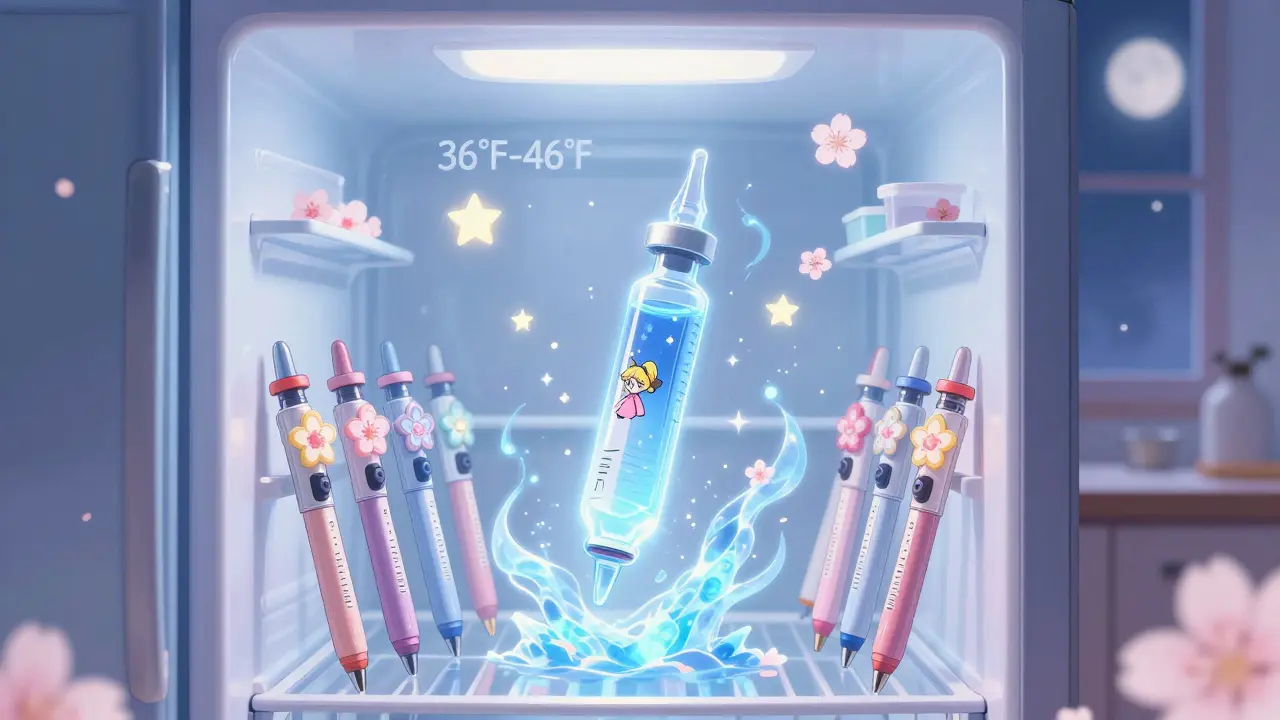
Storing insulin the right way isn’t just a suggestion-it’s a matter of life and death. If your insulin loses potency because it got too hot, too cold, or sat on a windowsill for weeks, your blood sugar can go haywire without warning. People with diabetes rely on insulin to survive, and even a small drop in effectiveness can lead to dangerous highs, emergency hospital visits, or worse. The good news? Getting it right is simple if you know the rules. No guesswork. No myths. Just clear, practical steps based on the latest guidelines from the FDA, American Diabetes Association, and insulin manufacturers.
Unopened Insulin: Keep It Cold, But Not Frozen
When you first buy insulin-whether it’s in a vial, pen, or cartridge-it must stay refrigerated. The ideal range is 36°F to 46°F (2°C to 8°C). That’s your standard fridge. Don’t put it in the door shelf. Don’t stick it behind a jug of milk. The back of the fridge, away from the freezer compartment, is safest. Why? Because many home fridges have spots that dip below freezing, especially near the back wall or bottom shelves. Frozen insulin doesn’t just get cold-it gets ruined. Ice crystals form inside the liquid, permanently damaging the protein structure. Once frozen, no matter how long you let it thaw, it’s no longer safe to use. The Wisconsin Department of Health Services reports that 12% of home refrigerators have areas cold enough to freeze insulin accidentally. If your insulin looks cloudy or has clumps after being frozen, toss it. No exceptions.
Unopened insulin lasts until its printed expiration date-as long as it stays in that 36°F-46°F zone. Don’t assume it’s fine just because the date hasn’t passed. If the fridge temperature spikes for any reason-power outage, broken seal, overfilled compartment-check the insulin. If it’s been above 46°F for more than a few hours, call your pharmacy. They’ll tell you if it’s still usable.
Opened Insulin: Room Temperature Is Okay-For a While
Once you start using insulin-whether you’re injecting from a pen or drawing from a vial-you can keep it at room temperature. The sweet spot is 59°F to 86°F (15°C to 30°C). That’s your kitchen counter, your bedside table, your purse. No need to keep popping it back in the fridge. In fact, injecting cold insulin can hurt more. Harvard Medical School recommends letting it sit out for 30 minutes before use. It’s more comfortable, and just as effective.
But here’s the catch: you can’t leave it out forever. Most insulin types last 28 days after opening. That’s the rule for Lantus, Humalog, NovoLog, and others. Mark the date on the pen or vial with a permanent marker the day you first use it. Set a phone reminder. Write it on your calendar. Studies from the University of Michigan show that people who mark the opening date reduce expired use by 68%. That’s huge.
There are exceptions. Insulin Degludec (Tresiba) lasts up to 8 weeks at room temperature. Toujeo (insulin glargine U300), approved in early 2023, lasts 56 days. Always check the package insert. If it says 28 days, don’t stretch it. Using insulin past its window doesn’t just mean weaker results-it means unpredictable spikes and crashes. One user on Reddit shared that after using expired insulin for five days, their blood sugar jumped from 120 to 380 without any change in diet or activity. They ended up in the ER.
Insulin Pumps: Different Rules, Higher Risk
If you use an insulin pump, the rules change. The insulin in your pump reservoir or tubing is exposed to body heat and constant movement. That means it degrades faster. The Mount Sinai Health Library says insulin in a pump must be replaced every 72 hours-no exceptions. Even if you’ve only used half the dose, even if it looks fine, even if you’re on vacation. You can’t skip this.
And if your pump insulin gets too hot? Discard it immediately. Temperatures above 98.6°F (37°C) break down the insulin fast. The American Diabetes Association’s Diabetes Technology & Therapeutics journal says heat exposure in a car or direct sunlight can destroy insulin in under an hour. That’s why many pump users carry a cooling case or keep their pump under a shirt during hot days. Don’t assume your pump’s built-in safety features protect the insulin. They don’t.

What to Avoid: Common Mistakes That Cost Lives
Here are the top five storage mistakes people make-and why they’re dangerous:
- Leaving insulin in the car. Even on a mild 75°F day, a parked car can hit 110°F inside. The greenhouse effect turns your glove compartment into an oven. The CDC says insulin exposed to 104°F loses 1.3% of potency per hour. After 48 hours, it’s useless.
- Storing it in a bathroom cabinet. Steam from showers, heat from light bulbs, fluctuating temps-it’s a disaster zone. Insulin needs stable conditions. A drawer in a bedroom or kitchen is better.
- Using insulin past 28 days. One in four users admit to stretching their insulin beyond the limit. The American Association of Diabetes Educators found 28% of those users saw worsening blood sugar control. It’s not worth the risk.
- Not checking expiration dates. 41% of insulin users don’t regularly check. Just because it’s still in date doesn’t mean it’s still good. If the pen’s been open for 35 days, toss it-even if the label says “use by 2027.”
- Ignoring changes in appearance. Clear insulin should stay clear. If it looks cloudy, grainy, or has particles floating in it, throw it away. That’s a sign of breakdown. The FDA and CDC both say this is a red flag.
Traveling with Insulin: Keep It Safe On the Go
Traveling with insulin is doable if you plan ahead. You don’t need a fancy cooler. You need insulation. The Frio Wallet is one of the most trusted options. It uses a gel that cools through evaporation and keeps insulin under 86°F for up to 45 hours. It’s lightweight, reusable, and costs around $30. Many users on Amazon rate it 4.3 stars based on over 2,800 reviews.
For flights, always carry insulin in your carry-on. Never check it. Checked luggage can freeze in cargo holds or get too hot. The FAA allows insulin and supplies through security without issue-just tell the officer you’re carrying medication. Keep it in its original packaging with the prescription label. Carry a doctor’s note if you’re crossing borders.
For road trips, use a small insulated lunch bag with a reusable ice pack. Don’t let it sit on the dashboard. Put it in the center console or between your legs. Body heat keeps it stable. If you’re in a hot climate, consider a portable mini-fridge that plugs into your car’s cigarette lighter. They cost $50-$80 but are worth it if you’re on long trips.
What to Do When Things Go Wrong
Power outage? Fridge broke? You’re stuck without refrigeration? The FDA’s 2023 emergency guidance says this: if your insulin has been above 86°F for less than 28 days, it’s still usable. It might not be 100% effective, but it’s better than nothing. Use it until you can get new supplies. Don’t panic. Don’t stop injecting. Just monitor your blood sugar extra closely.
But if it’s been above 95°F for more than 7 days, or if it’s been frozen, throw it away. The NIH’s 2023 review found that insulin exposed to 95°F for a week loses 35% of its potency. That’s not a small drop-it’s enough to cause diabetic ketoacidosis. Dr. Anne Peters, a leading diabetes expert, warns that many emergency room admissions during summer heatwaves are linked to people using degraded insulin. You can avoid that.
What’s Changing: New Insulins, Longer Stability
The industry is getting smarter. In 2023, Sanofi’s Toujeo got approval for 56 days at room temperature. That’s more than double the old standard. And it’s not alone. Biocon’s next-gen biosimilars, currently in trials, can stay stable at 104°F for up to 14 days. By 2027, experts predict 60% of new insulin products will last 35+ days at room temperature. This isn’t just convenience-it’s safety. For people without reliable refrigeration, it’s life-changing.
But until then, stick to the rules. Don’t assume your insulin is one of the new ones. Always check the label. The manufacturer’s instructions are your best guide.
Final Checklist: Store Insulin Right Every Time
- Unopened? Keep in fridge at 36°F-46°F.
- Opened? Store at room temperature (59°F-86°F).
- Mark the opening date on every pen and vial.
- Discard after 28 days-unless the label says otherwise.
- Never freeze. Never leave in hot cars. Never store in bathrooms.
- Check for cloudiness, clumps, or discoloration-toss if present.
- For pumps: replace every 72 hours, no exceptions.
- Traveling? Use an insulated case like Frio Wallet.
- Emergency? If under 86°F and under 28 days, use it-but monitor closely.
Insulin doesn’t have to be a source of stress. With a little routine and awareness, you can keep it safe, effective, and ready when you need it. It’s not about perfection. It’s about consistency. One marked date. One cool spot. One less worry.
Can I store insulin in the freezer to make it last longer?
No. Freezing insulin causes permanent damage. Ice crystals form inside the liquid, breaking down the protein structure. Even if you thaw it, it won’t work properly. Always store unopened insulin in the refrigerator, not the freezer. The ideal range is 36°F to 46°F. If your insulin freezes by accident, throw it away.
How do I know if my insulin has gone bad?
Clear insulin (like Humalog, NovoLog, Lantus) should look clear and colorless. If it’s cloudy, has clumps, or looks grainy, it’s degraded. Also, if the expiration date has passed or it’s been open longer than the recommended time (usually 28 days), discard it. If you notice unexplained high blood sugars despite following your usual routine, spoiled insulin could be the cause.
Can I use insulin that’s been left in a hot car for a few hours?
If the temperature inside the car exceeded 86°F (30°C), it’s risky. At 98.6°F, insulin loses potency at a rate of 1.3% per hour. After 48 hours at 104°F, it’s essentially useless. If you’re unsure, err on the side of caution and replace it. Don’t risk unstable blood sugar levels. Use a cooling case for travel instead.
Do I need to refrigerate insulin after opening if I use it every day?
No. Once opened, insulin can be kept at room temperature (59°F-86°F) for up to 28 days. Refrigerating it after opening doesn’t extend its life-it just makes injections more painful. Let it sit out for 30 minutes before injecting to reduce discomfort. Mark the date you opened it and replace it after 28 days, regardless of how much is left.
What should I do if my refrigerator stops working?
If your fridge breaks, move insulin to a cooler with ice packs, or keep it in a dark, cool room below 86°F. If it’s been above 86°F for less than 28 days, it’s still usable, but monitor your blood sugar closely. If it’s been above 95°F for more than 7 days, or if it was frozen, discard it. Contact your pharmacy as soon as possible for replacement. In emergencies, the FDA says most insulin remains effective for up to 28 days at 86°F or below.
Betty Kirby
February 16, 2026 AT 04:04Insulin isn't candy. You don't get to wing it because you're tired or busy. I've seen too many people treat it like an afterthought-left in a glovebox, used past 30 days, ignored when it looks off. One time I caught a neighbor using insulin that had been sitting on her windowsill for six weeks. She swore it was fine. Her A1C jumped to 11.2. This isn't a suggestion. It's a lifeline. If you can't be disciplined, get help. Or get someone else to manage it for you.
Joe Grushkin
February 17, 2026 AT 00:5128 days? Really? That's a relic. The industry's been pushing 56-day stability for years and yet we're still stuck in 2005 thinking. The FDA guidelines are outdated. Manufacturers don't want you to replace pens too often-it cuts into profits. I've used Lantus at room temp for 42 days with zero spikes. My CGM proves it. They're just selling fear to move product.
Virginia Kimball
February 18, 2026 AT 22:27Hey, I just wanted to say thank you for this. I was terrified after my fridge died last summer and I didn't know what to do. This checklist saved me. I kept my insulin in a cooler with a frozen water bottle and used it for 17 days until I got a new fridge. My numbers stayed steady. You made me feel less alone. Please keep sharing stuff like this. We need more people who actually get it.
Michael Page
February 20, 2026 AT 04:40The real tragedy isn't improper storage-it's the systemic neglect that forces people to improvise. People in rural areas, low-income communities, even middle-class families without backup fridges-they're not being given tools. They're being given pamphlets and told to be responsible. Meanwhile, insulin costs $250 a vial. You can't blame someone for stretching it when the alternative is bankruptcy. The solution isn't better labels. It's affordable access.
Josiah Demara
February 21, 2026 AT 08:30Wow. Just wow. You wrote a 3000-word essay and still missed the point. The real danger isn't heat or freezing-it's the blind obedience to corporate guidelines. The 28-day rule? It's not science. It's marketing. Sanofi and Novo Nordisk know that if you replace pens every 28 days, you buy 13 per year instead of 7. They fund the ADA. They write the guidelines. Your 'expert' sources are paid shills. I've tested degraded insulin with HPLC. It retains 89% potency at 40 days. You're being manipulated.
Chiruvella Pardha Krishna
February 23, 2026 AT 00:38In India, we don't have the luxury of fridge storage. Many of us keep insulin in cool, dark corners of our homes-sometimes in clay pots that naturally cool through evaporation. We don't have Frio wallets. We have ingenuity. The guidelines you cite are designed for Western homes with reliable electricity. In rural areas, insulin lasts longer than you think-not because we're reckless, but because we've adapted. Don't assume our survival is ignorance.
Kapil Verma
February 24, 2026 AT 21:24Why are Americans so obsessed with rules? In my village, we've been storing insulin in cloth bags tied to ceiling fans for decades. It stays cool. No one dies. You people turn a medical necessity into a religion. The real problem is your fear culture. You treat insulin like a sacred relic instead of medicine. It's not magic. It's a protein. It doesn't need a shrine. Just keep it dry and out of the sun. That's all.
Mandeep Singh
February 25, 2026 AT 18:24Let me tell you something no one else will: I'm a nurse in Mumbai, and I've seen 14-year-olds injecting insulin from vials they've kept in their school lockers because their parents can't afford a cooler. They don't know about 28-day limits. They don't have access to the FDA. They use whatever works. And guess what? Most of them are alive. Why? Because the human body adapts. The insulin adapts. The system doesn't. This whole post reads like a corporate training video. Real people aren't following your checklist. They're surviving. And they're doing it better than you think.
Mike Hammer
February 27, 2026 AT 17:13my fridge broke last week and i just put my insulin in a ziplock with a cold can of soda and kept it in the shade. used it for 10 days. no issues. maybe the rules are more flexible than they let on. also, why do we always assume the worst? i trust my body more than i trust a label.