
Imagine arriving at a security checkpoint only to have your critical medication confiscated because it's in a generic plastic organizer. Or worse, discovering that your insulin has frozen and crystallized in the cargo hold of a plane. These aren't just travel nightmares; they are real risks that can lead to medical emergencies. Whether you are managing a chronic condition or just carrying a few prescriptions, packing medications for air travel requires more than just tossing pills in a bag. You need a strategy that satisfies security agents and protects the chemical integrity of your medicine.
The Golden Rule: Stick to Original Packaging
It is tempting to use a weekly pill organizer to save space, but this is a mistake that often leads to delays. TSA is the Transportation Security Administration, the agency responsible for security screening at U.S. airports requires medications to remain in their original pharmacy containers. This isn't just a bureaucratic hoop; it's about safety. The original label contains your name, the drug name, the dosage, and the prescribing doctor's information.
From a chemical perspective, repackaging can be dangerous. Dr. Marcia Wyman from the Cleveland Clinic points out that transferring drugs to non-medical containers can expose them to light, moisture, or contamination. In some cases, this can degrade the potency of a medication by up to 30% within just 72 hours. If you absolutely must use an organizer for convenience, keep the original bottles in your bag as backup proof of the prescription.
Handling Liquids and the 3.4-Ounce Limit
Most travelers know the "3-1-1" rule for liquids, but medically necessary liquids are a major exception. You are allowed to carry liquid medications that exceed 3.4 ounces (100 mL) in your carry-on, provided you declare them to the security officer at the start of the screening process.
| Liquid Type | Standard Limit | Medical Exception | Requirement |
|---|---|---|---|
| General Toiletries | 3.4 oz (100 mL) | None | Clear plastic bag |
| Prescription Liquids | 3.4 oz (100 mL) | Reasonable Quantity | Declaration & Label |
| Max Carry-on Limit | N/A | Up to 2,000 mL | FAA Approval for >2L |
While there isn't a hard upper limit for essential liquids, the FAA is the Federal Aviation Administration, which regulates all civil aviation in the U.S. notes that quantities over 2,000 mL may require special approval. To avoid a scene at the X-ray machine, have your prescription or a doctor's note ready. If you're traveling with a child's ADHD medication or a large bottle of syrup, a pediatrician's letter on official letterhead can expedite the process significantly.
Temperature Control for Biologics and Insulin
If you use protein-based medications like insulin or biologics, the cargo hold is your enemy. Temperatures in a plane's belly can drop to -40°F, which causes irreversible crystallization. Always keep these in your carry-on. However, simply keeping them with you isn't enough; you need to maintain a strict temperature range of 2-8°C (36-46°F).
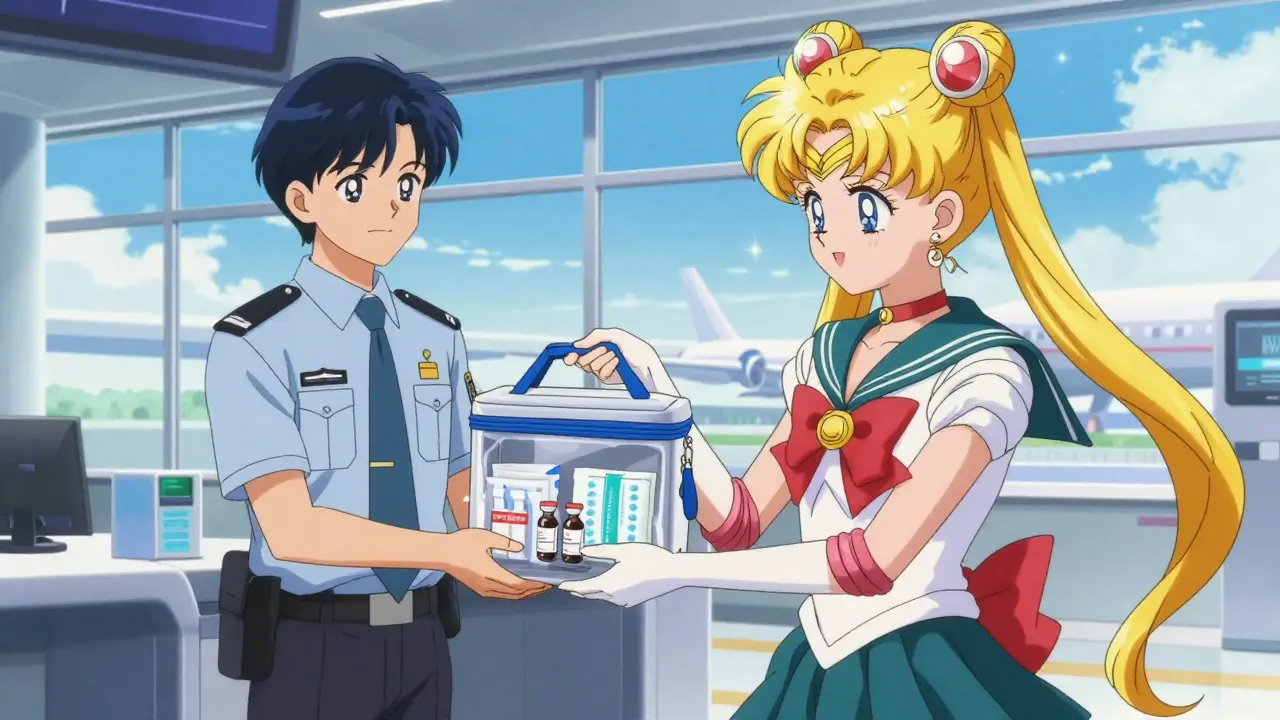
Use an insulated cooling bag with frozen gel packs. A pro tip from specialists at St. Jude Children's Research Hospital is to pre-freeze your ice packs for a full 24 hours before you leave. This ensures they stay cold for the 12-18 hours typical of long-haul travel. Be aware that Biologic Medications are complex proteins derived from living organisms, which are highly sensitive to heat and cold lose about 5% of their potency every hour they spend above 25°C (77°F). If you're flying on a newer United Airlines 787 Dreamliner, check if they have the on-board refrigeration units available for medical use.
Managing Needles, Syringes, and Pumps
Injectables are permitted through security as long as they are accompanied by the medication they are intended for. If you use an infusion pump or a continuous glucose monitor, do not remove the device unless specifically requested by security, though you should notify the agent immediately.
One of the most overlooked aspects of safety is disposal. You cannot simply throw a used needle into a terminal trash can. Following CDC guidelines, you must carry a dedicated sharps container. This prevents accidental needle sticks for airport staff and ensures you aren't violating hazardous waste laws in a foreign country.
International Rules and Local Regulations
Crossing borders adds a layer of complexity. What is legal in New Zealand or the US might be a controlled substance elsewhere. For example, countries like Japan and the UAE have very strict rules regarding medications containing pseudoephedrine. In Japan, you may be limited to a 72-hour supply unless you have prior authorization.
When heading abroad, prepare these three essential documents:
- A current prescription label on every bottle.
- A physician's letter explaining the medical necessity of the drug.
- A translated version of these documents if you're visiting a country where English isn't the primary language.
While the EU generally allows a 90-day supply, many Asian countries cap the limit at 30 days. Always check the U.S. Department of State's Travel Advisory or the International Society of Travel Medicine's database before you pack.

Pre-Flight Timeline and Scheduling
Don't leave your packing for the morning of your flight. Start your preparation 72 hours in advance. This gives you time to test your cooler's effectiveness and double-check that no prescriptions have expired. If you are crossing five or more time zones, you may need to adjust your dosing schedule. The American Academy of Sleep Medicine suggests shifting your medication time by 15-30 minutes daily for a few days before departure to avoid a sudden gap or overlap in your treatment.
On the day of travel, give yourself extra time. The TSA recommends arriving 2 hours early for domestic flights and 3 hours for international ones. If you have complex medical equipment or large quantities of liquid meds, this extra buffer prevents the stress that often leads to packing mistakes.
Can I put my medication in my checked bag?
You can, but it is highly discouraged. Checked bags are subject to extreme temperature swings-both freezing and overheating-which can destroy the potency of many drugs. Additionally, luggage can be lost or delayed, leaving you without critical medication. Always keep essential meds in your carry-on.
What if my medication doesn't have a label?
If the label is missing or illegible, you risk having the medication confiscated or facing significant delays. At a minimum, you must provide a valid prescription or a signed letter from your doctor on their official clinic letterhead that matches the medication in your possession.
Do I need a doctor's note for all medications?
Not for standard pills in original bottles. However, a note is strongly recommended for liquid medications over 100mL, injectable drugs, medical devices (like pumps), and any medication you are taking into a foreign country with strict import laws.
Are gel packs allowed through security?
Yes, frozen gel packs and ice packs used for medical purposes are permitted. They must be fully frozen when presented for screening to avoid being flagged as a "liquid" under the standard 3.4-ounce rule.
What is a digital medication passport?
It is a new blockchain-verified system introduced through a partnership between the TSA and MyMediTravel. It allows travelers to store their medical documentation digitally, which can speed up the security clearance process at participating airports.
Next Steps for Your Journey
Depending on your health needs, your final checklist will look different. If you are a frequent business traveler, look into the digital medication passport to reduce screening times. If you are a parent traveling with children, ensure all child-resistant caps are tight to prevent accidental exposure during turbulence. Finally, if you're visiting a country with restrictive laws, contact the nearest embassy or use a translation service 14 days before your trip to ensure your paperwork is legally compliant.