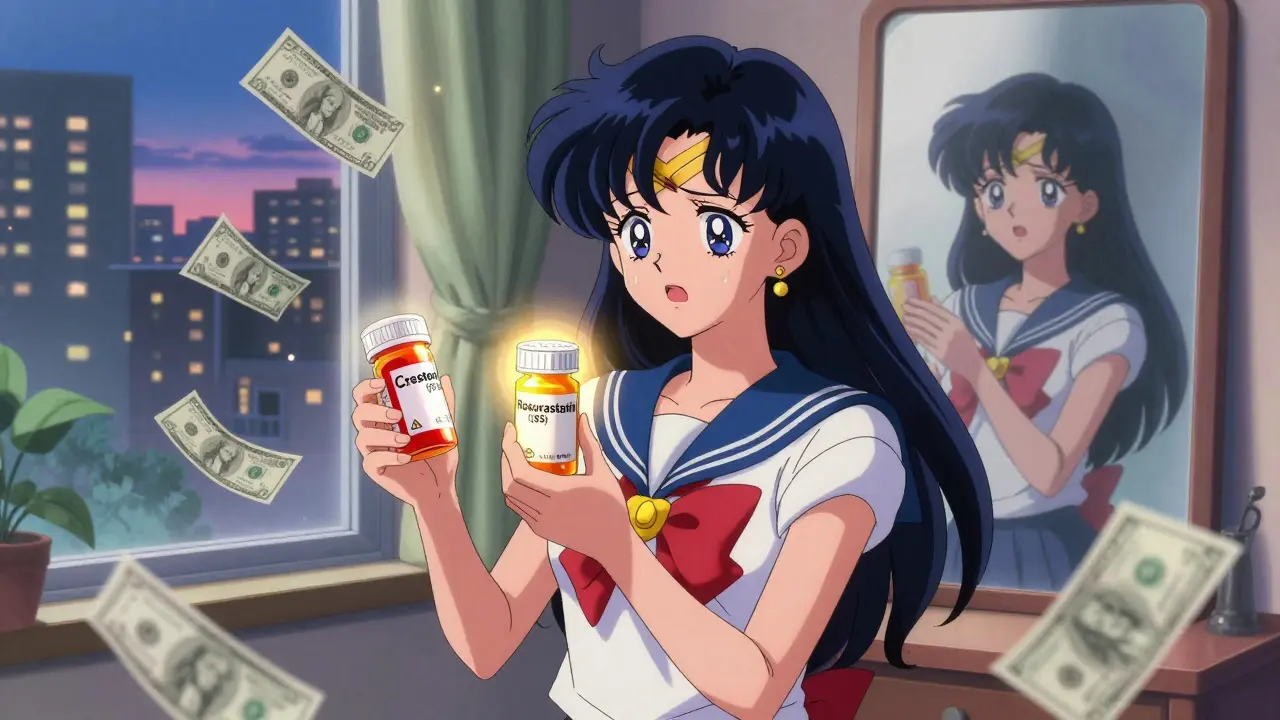
When Medications Are Too Expensive, People Skip Them
It’s simple: if a pill costs too much, people don’t take it. Not because they’re careless, but because they’re choosing between medicine and groceries, rent, or their child’s school supplies. In 2023, over 32% of U.S. adults admitted to skipping doses, delaying refills, or not filling prescriptions at all just to save money. That’s not negligence - it’s survival.
And the biggest driver? Out-of-pocket costs. When a brand-name statin like Crestor costs $75 per month, but the generic rosuvastatin is $5, the choice isn’t hard. One patient on Reddit said, “I went from missing 3-4 doses a week to perfect adherence for 11 months straight” after switching. That’s not anecdotal - it’s backed by data.
Generics Work Just as Well - and Cost 80-85% Less
The FDA doesn’t approve generic drugs lightly. To get the green light, a generic must contain the exact same active ingredient, strength, dosage form, and route of administration as the brand-name version. It must also prove it delivers the same amount of medicine into the bloodstream within a tight range - 80% to 125% of the brand. In plain terms: it works the same.
Yet, generics cost 80-85% less. Why? No expensive marketing, no patent protection, no brand-building. Just science and competition. In 2024, generics made up 90% of all prescriptions filled in the U.S., but only 23% of total drug spending. That’s $643 billion saved between 2009 and 2019 - money that went back into patients’ pockets and away from ER visits and hospital stays.
Every $10 Increase in Cost Drops Adherence by 2-4%
It’s not just about big price jumps. Even small increases matter. A 2022 review of 160 studies found that for every $10 rise in out-of-pocket cost, adherence drops by 2-4%. That pattern holds across conditions - from high blood pressure to diabetes to depression.
For GLP-1 weight-loss drugs like semaglutide, a 2023 study in Diabetes Care found that each $10 increase in cost reduced the chance someone would stick with the medication by 3.7%. And that led to a 5.2% spike in emergency room visits. That’s not a coincidence - it’s cause and effect.
Take breast cancer treatment. A 2011 study showed women on brand-name aromatase inhibitors had a 22.3% discontinuation rate. Those on generics? Only 17.8%. Adherence rates? 68.4% vs. 73.1%. The difference wasn’t in effectiveness - it was in price.
Insurance Tiers Are Hidden Barriers
Pharmacy benefit managers (PBMs) and insurers use tiered formularies to control costs - but they often hurt patients. A drug might be on Tier 1 (lowest cost, $5-$10 copay), Tier 2 ($30-$50), or Tier 3 ($100+). Brand-name drugs? Usually Tier 3. Generics? Tier 1.
When Medicare Part D moved atorvastatin and rosuvastatin from Tier 2 to Tier 1 in 2012, adherence jumped by 5.9% - even after adjusting for age, income, and other factors. That’s not a small bump. That’s thousands of people who started taking their meds consistently, reducing their risk of heart attack or stroke.
But here’s the problem: most patients don’t know their tier. They walk into the pharmacy expecting a $10 copay - and get hit with $80. That shock makes them walk out without the medicine.
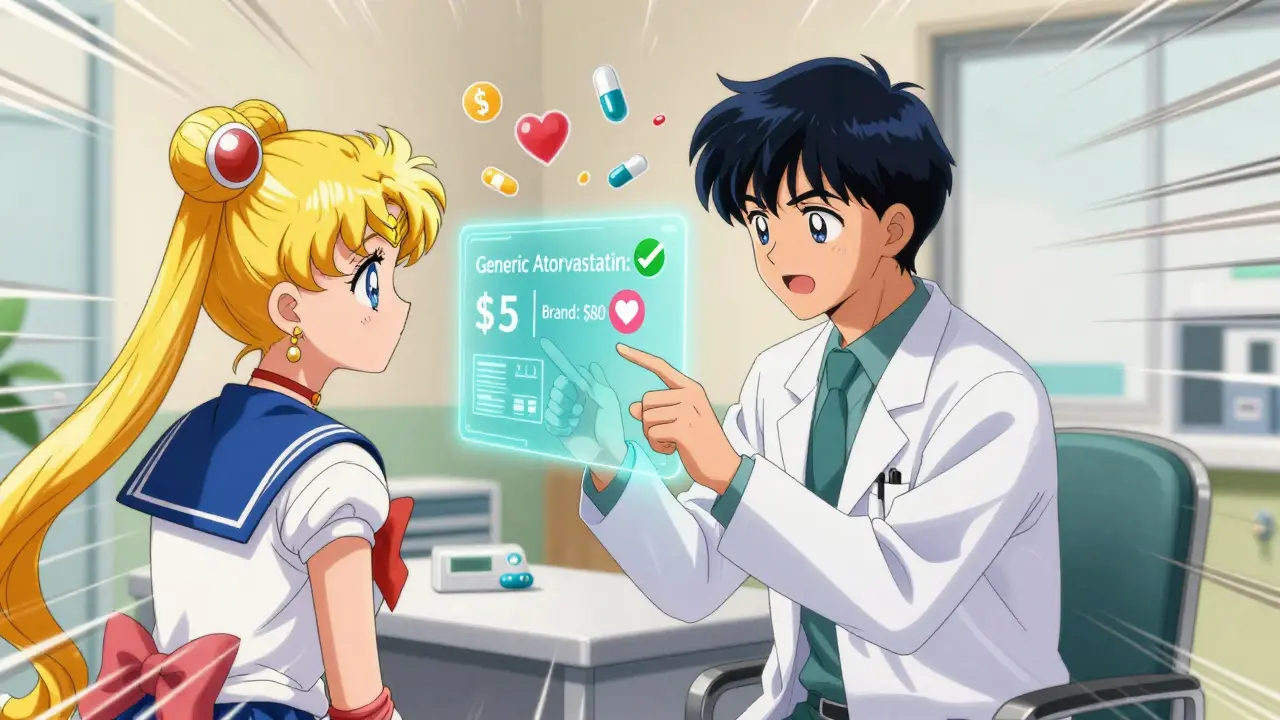
Real-Time Tools Are Changing the Game
Imagine your doctor typing your prescription - and right then, the screen pops up: “Generic rosuvastatin: $5 at CVS. Brand-name Crestor: $75.” That’s real-time benefit tools (RTBTs). They’re not magic, but they’re powerful.
Pilot programs using RTBTs saw adherence improve by 12-15%. One program, Magellan’s inforMED, reported a 40% reduction in care gaps and a 2:1 return on investment. That means for every dollar spent on the tool, two dollars were saved in avoided hospitalizations and ER visits.
But adoption is slow. Only about 30% of electronic health record systems are fully integrated with RTBTs. Many doctors still don’t use them. And even when they do, patients report being upset if their doctor sees the price but doesn’t talk about it. Over half of patients who’ve skipped meds because of cost said they’d be “moderately or extremely upset” if their doctor didn’t mention cheaper options.
What’s Changing in 2025? A Big One
The Inflation Reduction Act of 2022 didn’t just tweak the system - it rewrote the rules. Starting in 2025, Medicare Part D will cap out-of-pocket drug costs at $2,000 per year. Insulin? Already capped at $35 a month since 2023. Catastrophic coverage gaps? Eliminated.
The Congressional Budget Office estimates this will improve adherence for 1.4 million Medicare beneficiaries. That’s not just numbers - that’s people who can finally afford their heart meds, their diabetes pills, their antidepressants.
And it’s not just Medicare. Private insurers are starting to follow. Value-based insurance design - where copays are tied to how effective a drug is, not how expensive - is being tested. In diabetes and heart disease trials, it boosted adherence by 18.3%.
Why Don’t More People Use Generics?
There’s a myth: “Generics are weaker.” It’s false. But it’s persistent. A 2021 survey in U.S. Pharmacist found that even though generics are just as effective, adherence rates are still 15-20% higher for them - not because they work better, but because they’re cheaper.
Patients don’t trust them. Some think “cheap” means “low quality.” The FDA’s “It’s Okay to Use Generics” campaign tried to fix that. But awareness is still low. Pharmacists can help - if they’re trained to explain bioequivalence in plain language.
Another issue? Therapeutic duplication. Doctors sometimes prescribe two drugs for the same condition - maybe because they didn’t check the formulary, or because the patient was on a brand before. That adds $100-$200 a month in unnecessary cost. Medication therapy management programs can catch this - but they’re underused.

What Happens When People Don’t Take Their Meds?
It’s not just about feeling worse. It’s about dying.
Medication non-adherence causes up to 100,000 preventable deaths each year in the U.S. It’s responsible for 50% of treatment failures. And it costs the system $100-$300 billion annually in avoidable hospitalizations, ER visits, and long-term complications.
Think about it: a patient with high blood pressure skips doses because they can’t afford the $90 copay. Their pressure spikes. They have a stroke. The hospital bill: $150,000. The generic pill? $5. The difference isn’t just money - it’s life.
What Can You Do?
If you’re on a chronic medication:
- Ask your doctor: “Is there a generic version?”
- Ask your pharmacist: “What’s the cash price at Walmart or Costco? Sometimes it’s cheaper than insurance.”
- Use GoodRx or SingleCare to compare prices across pharmacies.
- If your copay is over $20, ask if your insurer has a copay assistance program.
- Don’t be afraid to say: “I can’t afford this. What else works?”
If you’re a caregiver or family member: help them check prices. Many older adults don’t know how to use apps or websites. A simple phone call to the pharmacy can save hundreds.
And if you’re a provider: use your EHR’s real-time pricing tool. Talk about cost. Even if it’s just one sentence: “This generic works just as well and costs less than a coffee a day.”
Bottom Line: Lower Price = Better Health
It’s not complicated. When drugs are affordable, people take them. When people take them, they stay healthier. When they stay healthier, hospitals fill fewer beds, and the system saves billions.
Generics aren’t a compromise. They’re the smartest, most proven tool we have to fix a broken system. The data is clear. The solutions exist. What’s missing is the will to use them - for every patient, every time.
Oladeji Omobolaji
January 21, 2026 AT 13:08Janet King
January 22, 2026 AT 03:43Vanessa Barber
January 23, 2026 AT 19:09dana torgersen
January 23, 2026 AT 23:49Dawson Taylor
January 24, 2026 AT 11:54Sallie Jane Barnes
January 24, 2026 AT 14:25Andrew Smirnykh
January 25, 2026 AT 09:32Laura Rice
January 26, 2026 AT 21:41charley lopez
January 26, 2026 AT 23:16Kerry Evans
January 27, 2026 AT 00:06Susannah Green
January 27, 2026 AT 17:25Anna Pryde-Smith
January 28, 2026 AT 08:46Kerry Moore
January 29, 2026 AT 12:38