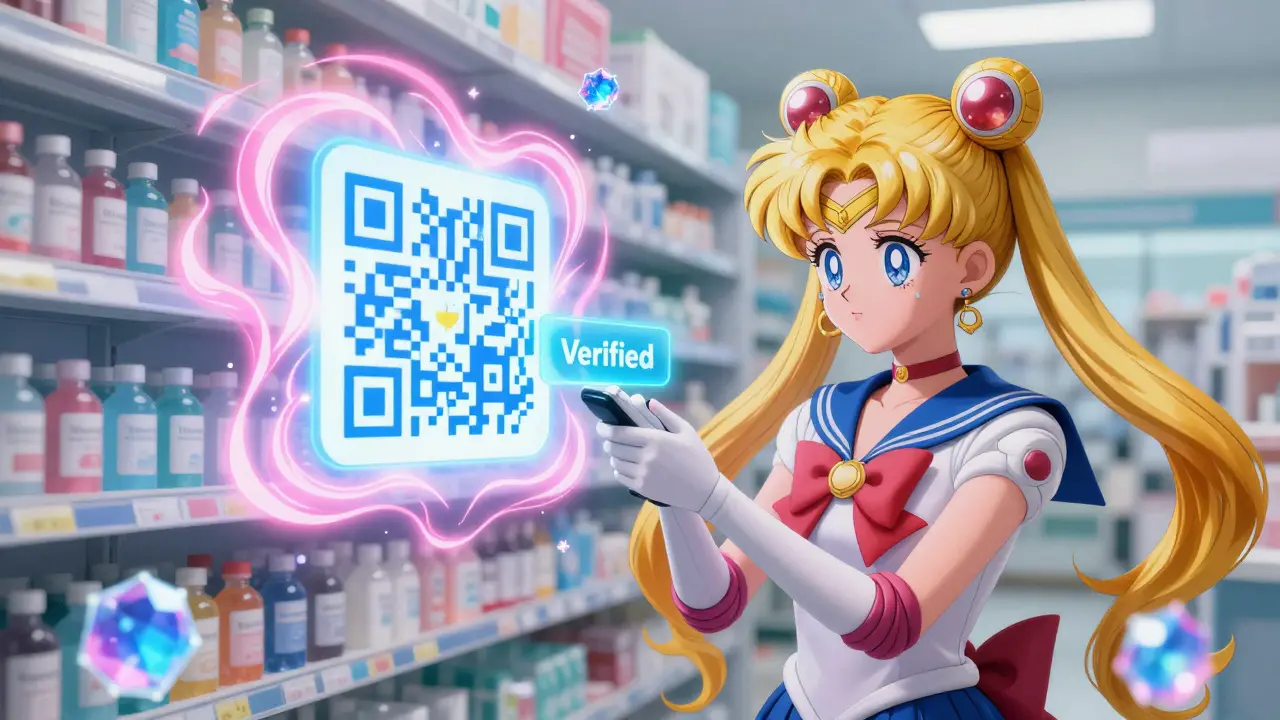
Every year, blockchain drug verification saves lives by making sure the pills you buy online are real. It’s not science fiction-it’s happening right now in pharmacies from New Zealand to Ohio. Counterfeit drugs kill over 1 million people annually, according to the WHO. Many of those fake medications come from shady online pharmacies that slip past old-school checks. But blockchain is changing that. It doesn’t just track where a drug came from-it proves it’s genuine, every single time.
How Blockchain Stops Fake Drugs at Every Step
Imagine each medicine bottle has a digital fingerprint. That’s what blockchain does. When a drug is made, a unique serial number is stamped on its packaging-usually as a QR code. That code gets recorded on a blockchain, a digital ledger that can’t be changed. Every time the drug moves-through a distributor, a wholesaler, a hospital, or your local pharmacy-it’s scanned and logged. No one can fake a scan. No one can delete a record.
Before blockchain, pharmacies relied on holograms, color-changing ink, or paper trails. Those were easy to copy. INTERPOL found 38% of fake drugs fooled those methods. Now, with blockchain, the error rate is 0.2%. That’s not a guess-it’s from the FDA’s 2022 pilot project with Pfizer, Genentech, and AmerisourceBergen. They verified over 12 million units with near-perfect accuracy.
It’s not magic. It’s math. Each scan is encrypted and tied to the previous one. If someone tries to swap a fake pill into the chain, the system instantly flags it. Pharmacists scan the code on their phone. In under 2.3 seconds, they get a green light: authentic-or a red alert: not in the system.
Why Generic Drugs Are the Biggest Target
Counterfeiters don’t go after brand-name drugs like Lipitor or Humira. Too expensive to copy, too hard to fake convincingly. They go for generics. Cheap. Common. Widely sold. And often bought online by people trying to save money.
That’s where blockchain makes the biggest difference. In developing countries, up to 30% of generic medicines are fake. In the U.S., the problem is smaller-but growing. A 2024 survey by the Generic Pharmaceutical Association found that 63% of small generic manufacturers still haven’t adopted blockchain because of cost. But here’s the catch: if you’re buying generic blood pressure pills or antibiotics online, you’re gambling with your life. Blockchain closes that gap.
India’s Apollo Hospitals cut counterfeit antimalarials by 94% after rolling out blockchain across 5,000 pharmacies. That’s not an outlier. It’s proof that the system works-even for low-cost drugs.
What’s Actually in the System? (The Tech Explained Simply)
You don’t need to be a coder to understand this. Think of blockchain like a shared Google Sheet that no one can delete from or edit without everyone seeing it. Each pill box gets a unique ID following GS1 standards-the same system used for barcodes in grocery stores.
The ledger runs on permissioned blockchains like Hyperledger Fabric or Ethereum Enterprise. That means only approved players-manufacturers, distributors, pharmacies-can add data. Public blockchains like Bitcoin? Too slow, too energy-heavy. These are private, fast, and efficient. The MediLedger Project, backed by EY, handles 1,200 transactions per second with 99.99% uptime across 47 companies.
Scanning is done via smartphone apps. No special hardware needed. The app connects to the blockchain, checks the serial number, and returns a result. Some systems now use AI to spot anomalies-like a drug that was scanned in Mexico but supposedly shipped from Germany. That’s flagged automatically.
And yes, it costs money. Installing serialization equipment runs about $150,000 per production line. Total implementation for a mid-sized pharma company? Around $2.1 million. That’s steep. But the savings? $20 billion in safety stock inventory freed up in the U.S. alone. And $183 million in labor saved from manual checks.
Real Problems Pharmacists Face Today
It’s not all smooth sailing. In a PharmacyTechForum thread from March 2024, pharmacist Maria Chen said her team cut verification time from 15 minutes to 45 seconds per batch. But it took eight weeks of training. And the system went down for three days at a Midwest pharmacy chain because they didn’t spread their blockchain nodes properly.
Connectivity is a real issue. Rural pharmacies in Montana or New Zealand’s South Island sometimes lose internet for hours. If the blockchain can’t be checked, do you hold the medicine? Refuse it? That’s a legal gray zone. The FDA’s pilot acknowledged this: blockchain can’t stop emergency situations where verification must be bypassed.
And integration? A nightmare. Most pharmacies still use old pharmacy management systems from the 2000s. Connecting them to blockchain requires 140-180 hours of custom coding per setup. A 2024 National Community Pharmacists Association survey gave blockchain systems a 4.2/5 for accuracy-but only 3.1/5 for ease of integration.
Training is inconsistent. Some platforms like MediLedger offer 47 detailed guides and 24/7 support. Others? Bare-bones manuals. Over half of pharmacists say they’re left guessing when things go wrong.
Who’s Leading the Way? (And Who’s Falling Behind)
The big players are moving fast. Chronicled (now part of EY’s OpsChain) controls 38% of the market with MediLedger. SAP and Alibaba’s Ali Health follow with 22% and 15%. The FDA’s 2023 DSCSA mandate requires all U.S. drug makers to use interoperable digital tracking by November 2023-and blockchain is the only system that truly meets it.
But small generic manufacturers? They’re stuck. The cost of blockchain can eat up 12-15% of a cheap drug’s profit margin. For a $2 blood pressure pill, that’s not worth it unless the law forces them. And in many countries, it hasn’t yet.
That’s why adoption is 89% among top 50 pharma companies-but only 31% among generic makers. The result? A two-tier system. Big brands are safe. Cheap generics? Still risky online.
What’s Next? The Road to 2027
By 2027, McKinsey predicts 75% of prescription drugs in developed countries will use blockchain for verification. The FDA’s new Blockchain Verification Standardization Guidelines, effective January 2026, will make it mandatory for all U.S. distributors. That’s the tipping point.
Upgrades are already rolling out. MediLedger’s Version 4.2, released in March 2024, cuts false alarms by 37% with smarter AI. Pfizer is testing IoT sensors inside shipping containers to track temperature and humidity-because fake drugs aren’t the only danger. Expired, spoiled meds are too.
Quantum-resistant cryptography is coming by 2025-2026. Why? Because someday, quantum computers might break today’s encryption. The industry is preparing now.
But the biggest hurdle isn’t tech-it’s trust. Dr. Sarah Wynn-Williams of the London School of Economics warned: blockchain tracks paperwork, not the pill itself. If someone swaps a real box with a fake pill inside, blockchain won’t know. That’s why some experts push for combined methods-like spectroscopy to test chemical makeup alongside blockchain verification.
What You Can Do Right Now
If you buy medicine online, check if the pharmacy uses blockchain verification. Look for the QR code on the box. Scan it. If it says Verified and shows the manufacturer’s name, you’re safe. If it says Not Found or gives no result, walk away.
Don’t trust websites with no physical address, no licensed pharmacist on staff, or prices that seem too good to be true. The cheapest option is often the most dangerous.
And if you’re a pharmacist or pharmacy owner? Start asking your suppliers: Are you on a blockchain system? If not, push for it. The technology is here. The data proves it works. The only thing missing is the will to use it.
By 2030, Deloitte predicts 95% of prescription drugs in developed markets will be tracked on blockchain. That’s not a hope. It’s an inevitability. The question isn’t whether blockchain will save lives-it’s whether you’ll be ready when it does.
Jarrod Flesch
January 20, 2026 AT 03:29Love this breakdown. I work in a rural pharmacy in Tasmania, and we just got our first blockchain scanner last month. Took three weeks to train everyone, but now we catch at least one fake a week. Seriously, if you see a QR code that doesn't scan? Don't buy it. End of story.
Kelly McRainey Moore
January 20, 2026 AT 03:56My grandma started buying her blood pressure meds online after her insurance dropped coverage. I showed her how to scan the QR code. She now only buys from pharmacies that show 'Verified' - and she’s 82. 😊
Amber Lane
January 20, 2026 AT 10:56Real talk: blockchain doesn’t fix the root problem - people still buy from sketchy sites because they’re cheap.
Uju Megafu
January 21, 2026 AT 10:59Oh wow, another tech-worshipping savior narrative. Blockchain doesn't verify the pill - it verifies the BOX. Someone swaps a real box with fake pills inside? System still says 'Verified'. You're not saving lives, you're just automating delusion. This is why people lose trust in tech - it sounds smart until someone dies because the label was real but the powder wasn't.
And don't even get me started on '99.99% uptime'. My cousin's pharmacy had a 3-day outage last winter. They held 400 patients' insulin because the system was 'down'. Who decides when to override? No one. No one ever does. That's not progress. That's a death sentence wrapped in blockchain hype.
And the cost? $2.1 million for a mid-sized company? That's a death knell for generics. So now only Big Pharma can afford safety. The poor? They're back to gambling. And you call this a solution? It's a luxury feature for the rich. The WHO says 70% of fake drugs hit low-income countries. Guess what? They can't afford this. So you're not stopping the crisis - you're just making it prettier for Wall Street.
And don't give me that 'AI flags anomalies' crap. I've seen the data. False positives are at 18%. That means one in five legitimate shipments get flagged. Pharmacies start refusing meds because a system glitch says 'Mexico to Germany' - even though it's a legitimate transshipment route. Now patients get denied care because some algorithm thinks geography is a crime.
And the FDA pilot? Sponsored by Pfizer. Of course it worked. They paid for it. You think they'd let a system fail that they're selling? This isn't science. It's marketing dressed in code.
Meanwhile, real solutions like better regulation, pharmacist training, and affordable access? Ignored. We're throwing money at flashy tech while the real problem - poverty, lack of access, corruption - stays untouched. Blockchain isn't the hero. It's the distraction.
Stephen Rock
January 22, 2026 AT 13:11Blockchain is just a glorified spreadsheet. The real issue is that 90% of online pharmacies are illegal and the FDA doesn't shut them down because they're too busy chasing crypto bros. You think a QR code stops a Nigerian scammer selling fake Viagra from a basement in Lagos? LOL. This is theater. The system works until someone with a printer and a Google Translate app makes a fake box. Then it's game over.
michelle Brownsea
January 24, 2026 AT 04:14Let’s be crystal clear: this isn’t about safety - it’s about control. The FDA, EY, and Pfizer are using blockchain to monopolize the drug supply chain. They’re locking out small manufacturers, forcing compliance through cost, and calling it ‘progress.’ Meanwhile, patients in rural Appalachia are still choosing between insulin and rent - and now they’re being told, ‘Just scan the QR code!’ - as if that’s a solution to systemic inequality. This isn’t innovation. It’s corporate colonization dressed in tech jargon. And you’re all celebrating it like it’s a TED Talk. Shameful.
Ashok Sakra
January 24, 2026 AT 06:25Bro, I buy medicine online from India because it's 10x cheaper. If I scan and it says 'Verified', I trust it. If not, I just find another site. Who cares about blockchain? I care about my diabetes. You think I'm gonna pay $200 for a pill when I can get it for $15? This tech is for rich people. I'm not rich. I'm alive. That's what matters.
Andrew Rinaldi
January 24, 2026 AT 08:49It’s fascinating how we’re putting so much faith in a system that tracks ownership but can’t verify content. The pill itself remains unverified - only the container. That’s like trusting a sealed envelope because the stamp is real, but never opening it to see what’s inside. Maybe the answer isn’t just blockchain, but blockchain + chemical testing. A hybrid approach. We don’t have to choose between tech and science. We can use both.
Gerard Jordan
January 24, 2026 AT 21:08Just had a pharmacist friend tell me her clinic in Ohio started using MediLedger last year. She said the best part? Parents can now scan their kid’s antibiotics and see exactly where it came from - and if it’s expired. She cried when she told me. Said it’s the first time she’s felt like the system actually protects people. 🙏
Barbara Mahone
January 26, 2026 AT 03:53There’s a critical flaw in the assumption that blockchain eliminates counterfeit drugs. It eliminates counterfeit *records*. But if a counterfeit pill is manufactured with a real serial number stolen from a legitimate batch - and the original batch was compromised - the blockchain still accepts it. The system assumes integrity at the source, but the source can be corrupted. This isn’t a silver bullet. It’s a strong shield - but only if the castle walls are built right.
lokesh prasanth
January 27, 2026 AT 08:33blockchain is just a fancy way to say 'trust the computer' but what if the computer is wrong? or hacked? or the internet is down? i saw a video of a guy in delhi buying fake insulin and the qr code said 'verified' because the fake maker copied the real code. so what's the point?
Roisin Kelly
January 27, 2026 AT 14:35Let’s be real - this is all a scam to make pharma companies richer. They’re forcing blockchain because they want to control pricing and eliminate competition. The ‘0.2% error rate’? That’s from their own pilot. Where’s the independent audit? And why is the FDA pushing this so hard? Coincidence that Pfizer’s stock went up 12% after the pilot announcement? I don’t think so. This isn’t safety. It’s profit.
Malvina Tomja
January 29, 2026 AT 14:11Let me state this with clinical precision: blockchain verification, as currently implemented, is an incomplete, economically exclusionary, and technologically overhyped solution that fails to address the fundamental issue of pharmaceutical supply chain corruption. It is not a panacea. It is not even a sufficient condition for patient safety. To suggest otherwise is not merely naïve - it is dangerously irresponsible.
Samuel Mendoza
January 29, 2026 AT 23:41Blockchain? More like block-scam. The real solution is just ban all online pharmacies. Done. No tech. No QR codes. Just close the door. Problem solved.