
Every year, millions of people miss doses of their medications-not because they forget, but because life gets busy. A prescription for high blood pressure, diabetes, or cholesterol might sit on the counter, untouched for days. The problem isn’t laziness. It’s complexity. Multiple pills. Different times. Side effects that confuse. And no one to remind you when you’re rushing out the door or sleeping through the alarm.
That’s where medication reminder apps come in. These aren’t just fancy alarms. They’re smart tools built by doctors, pharmacists, and engineers to help people stick to their treatment plans. And the data shows they work. In a 2023 study of patients in federally qualified health centers, those using Medisafe improved their adherence by 43%. Compare that to the control group, which only improved by 10%. That’s not a small win. That’s life-changing.
How These Apps Actually Help You Take Your Pills
Most people think a medication app is just a phone alarm that says, "Take your blood pressure pill." But the best ones do so much more. They track what you’ve taken, warn you about dangerous drug interactions, let you share your progress with family or your doctor, and even explain why each pill matters.
Take Medisafe. It doesn’t just buzz at 8 a.m. It asks: "Did you take your metformin?" If you say no, it nudges you again in 15 minutes. If you say yes, it logs it. Over time, it builds a visual chart showing your adherence streak. You can see, right on your screen, that you’ve taken your pills correctly for 27 days straight. That kind of feedback is powerful. It turns a chore into a game you can win.
Apps like MyTherapy go further. They let you log how you feel after taking a pill. Did your joint pain ease? Did you feel dizzy? That data isn’t just for you. Your doctor can see patterns over weeks. Maybe your blood pressure drops too low after lunch. Maybe your mood dips after your statin. That’s information no paper logbook can give.
What Makes One App Better Than Another?
Not all apps are created equal. Some are just glorified timers. Others are built with real clinical evidence behind them. Here’s what separates the good from the great:
- Personalization: Can you set different reminders for each pill? Can you choose whether you want a sound, vibration, or text message? Can you adjust times if you travel or change your schedule?
- Condition-specific design: Apps built for hypertension, like those studied in the 2025 JMIR review, include tailored education. They explain why your BP numbers matter. General apps don’t.
- Integration: Does it connect to your pharmacy? Can your doctor pull your adherence data from your EHR? Medisafe and CareZone use FHIR APIs to sync with health systems-this is critical for continuity of care.
- Security: Your health data is private. Look for apps that use AES-256 encryption and follow HIPAA standards. If they don’t say this clearly, avoid them.
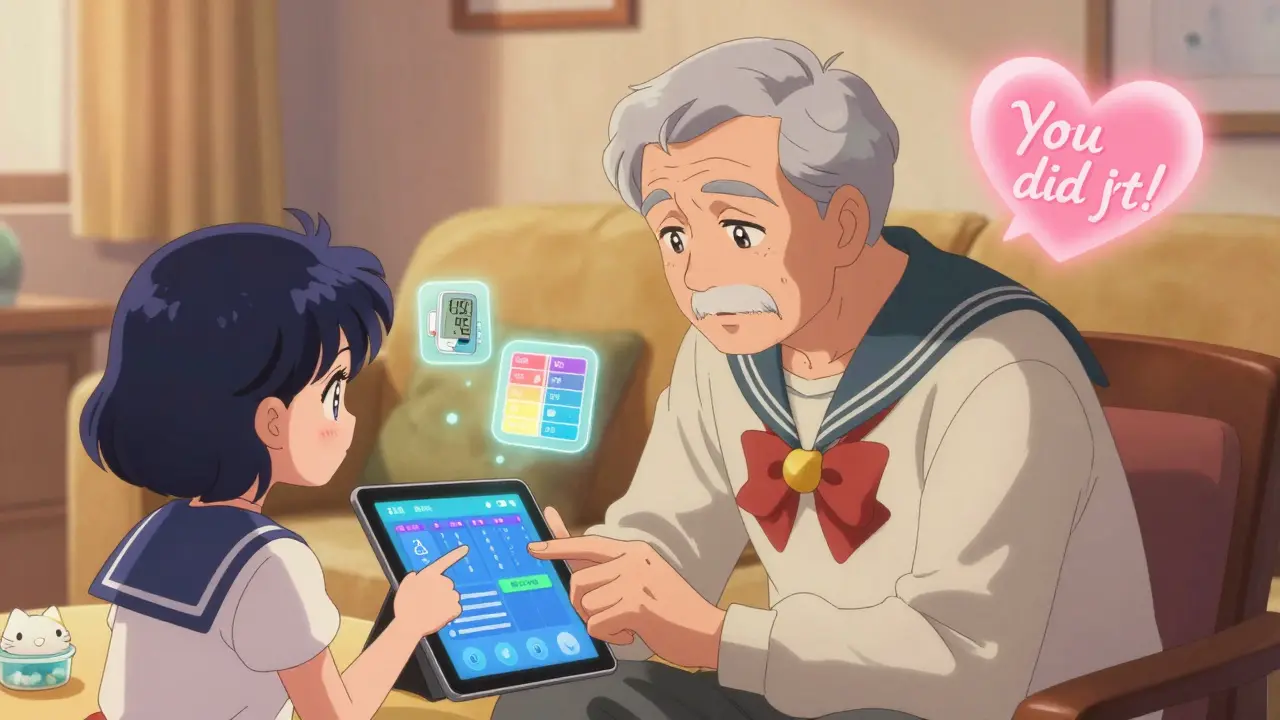
One app that stands out is Round Health. It’s designed for older adults. The interface is large, the buttons are simple, and it allows family members to receive alerts if a dose is missed. In a 2024 trial with seniors in New Zealand, 82% of users said they felt more confident managing their meds after using it for six weeks.
Why Some People Still Don’t Stick With Them
It’s not that apps don’t work. It’s that they’re not always used right. The NIHR 2023 analysis found that 5 out of 9 studies saw only small or no improvements. Why? Three big reasons:
- Too complex to set up: One user on Reddit said, "I spent 40 minutes trying to add my 12 pills. I gave up." The NIH study found the average setup time was 22 minutes. If you’re 75 and not tech-savvy, that’s a barrier.
- No personal connection: Apps that just blast reminders without explaining "why" lose people. If you don’t understand why your cholesterol pill matters, you’ll skip it when you feel fine.
- App abandonment: A 2025 JMIR review found that 7 of the 14 apps studied were no longer being updated. That’s a red flag. If the company stopped maintaining it, your data could vanish.
And then there’s the digital divide. Older adults, low-income users, and people without reliable internet are the ones who need these tools most. But they’re also the least likely to have a smartphone, data plan, or confidence using apps. Dr. Michael Johnson from the American Pharmacists Association put it bluntly: "The people who need digital help the most are often the least equipped to use it."
Real User Stories: What People Are Saying
On the iOS App Store, Medisafe has a 4.7-star rating. Here’s what users say:
- "I take 8 pills a day. I used to mix them up. Now I know exactly what I’ve taken. My doctor said my numbers have never been better." - u/MedUser2023
- "The visual calendar helped me see I was skipping my antidepressant on weekends. I fixed that. My mood is stable now." - u/HealthTracker
But it’s not all perfect. Some users report:
- Battery drain (23% of iOS complaints)
- Notifications that don’t come through (31% of Android complaints)
- Apps that crash when you add too many medications
One man in Auckland, 71, told his pharmacist: "I tried three apps. Two didn’t work on my old phone. The third kept telling me to update iOS. I just gave up." He now uses a simple pill organizer with alarms on his basic phone. Sometimes, low-tech works better than high-tech.
What the Experts Say About the Future
Dr. Sarah Ahmed, lead author of the 2025 JMIR review, says: "We’re moving beyond reminders. The next wave is prediction."
Medisafe’s 2025 update now uses AI to predict when you’re likely to miss a dose. It looks at your past behavior-did you skip pills on rainy days? After a bad night’s sleep? When you were stressed at work? Then it sends a tailored message: "You skipped your pill last time you felt anxious. Want to take it now?"
Another trend? Smart pill bottles. Companies are starting to build bottles that beep when opened, and sync with apps to confirm you took your dose. The Digital Medicine Society predicts 35% of apps will integrate with these by 2027.
But the biggest hurdle isn’t technology. It’s payment. Right now, most apps are free or cost $5/month. But if they’re proven to reduce hospital visits, why shouldn’t insurance cover them? Rock Health’s 2025 analysis found that apps with clear clinical results-like the 43% adherence jump-are 3.2 times more likely to get reimbursed by insurers. That’s the future: not just apps you buy, but tools your doctor prescribes.

How to Choose the Right App for You
Here’s a simple checklist:
- Start with your needs: Do you take one pill a day? Two? Ten? Complex regimens need apps with strong organization tools.
- Check compatibility: Does it work on your phone? iOS 13+ or Android 8+? Older phones? Try the free version first.
- Look for personalization: Can you change reminder times? Add notes? Link to your doctor’s portal?
- Read reviews from real users: Not just stars-look for comments about reliability and ease of use.
- Ask your pharmacist: They know which apps work with local pharmacies and insurance.
Top apps in 2026 based on user ratings and clinical evidence:
- Medisafe: Best overall. Strong integration, AI features, multilingual support.
- MyTherapy: Best for tracking symptoms and mood. Great visuals.
- Round Health: Best for seniors. Simple, family-friendly, reliable.
- CareZone: Best for caregivers. Lets family members help manage meds.
- Mango Health: Best for rewards. Earn points for taking pills-redeem for gift cards.
Don’t feel pressured to use an app if it doesn’t fit. A simple pillbox with alarms on a basic phone is better than a fancy app you never open.
What If You’re Not Tech-Savvy?
You don’t need to be a tech expert to use these tools. The NIH study found that 87% of older adults in underserved communities mastered the basics after just one 15-minute training session. Here’s how to get started:
- Ask a family member, friend, or pharmacist to help you set up one app.
- Start with just two or three pills. Don’t try to add everything at once.
- Use the app for one week. See how it feels.
- If it’s too hard, try a different app-or go back to a pill organizer.
There’s no shame in using a paper chart. But if you’re ready to try something better, digital tools are now reliable enough to make a real difference.
Final Thought: It’s Not About Technology. It’s About Trust.
Medication adherence isn’t a tech problem. It’s a human one. People skip pills because they’re scared, confused, overwhelmed, or feel like their meds don’t work. Apps can’t fix that alone.
But when an app gives you clarity, when it shows you your progress, when it reminds you gently-not with guilt-it can rebuild trust. Trust in your treatment. Trust in your body. Trust that you’re doing the right thing.
That’s the real power of these tools. Not the notifications. Not the charts. But the quiet confidence that comes from knowing you’re in control.
Do medication reminder apps really work?
Yes, when used correctly. A 2020 meta-analysis found that apps improved medication adherence with a Cohen’s d effect size of 0.40-stronger than motivational interviewing or educational pamphlets. Studies show users are nearly twice as likely to take their meds as prescribed compared to those using no digital tools.
Which app is best for elderly users?
Round Health is designed specifically for older adults. It has large buttons, simple navigation, and lets family members receive alerts if a dose is missed. Medisafe and MyTherapy also offer easy-to-use interfaces, but Round Health’s design focuses on reducing cognitive load, which is critical for seniors.
Can these apps connect to my doctor or pharmacy?
Some can. Medisafe, CareZone, and MyTherapy support FHIR APIs, which allow secure sharing of adherence data with electronic health records. Not all pharmacies integrate yet, but 47% of U.S. health systems now use some form of digital adherence tool. Ask your provider if they can access your app data.
Are these apps safe and private?
Reputable apps follow HIPAA standards and use AES-256 encryption for data at rest and TLS 1.2+ for data in transit. Avoid apps that don’t mention security. Always check the privacy policy. Never use an app that asks for your Social Security number or insurance details unless it’s from a known healthcare provider.
What if I don’t have a smartphone?
You don’t need a smartphone. Simple pill organizers with built-in alarms, or even a basic phone set to remind you, can be just as effective. The goal isn’t the device-it’s consistency. A paper chart taped to your fridge works if it gets you to take your pills on time.
Do insurance companies pay for these apps?
Most don’t yet-but that’s changing. Apps that prove they reduce hospital visits and ER trips are starting to be covered under value-based care programs. Rock Health found apps with strong clinical outcomes are 3.2 times more likely to get reimbursed. Ask your insurer if they cover digital adherence tools.
Jenci Spradlin
January 7, 2026 AT 15:05man i tried medisafe and it kept nagging me till i uninstalled it. like bro, i know i missed my pill, i dont need a notification every 15 mins like i’m a toddler. just let me be.
Heather Wilson
January 9, 2026 AT 04:40While the article presents a compelling narrative around digital adherence tools, it critically overlooks the structural socioeconomic determinants that render such interventions fundamentally inequitable. The implicit assumption that technological adoption is a viable solution for all demographic cohorts is not only empirically unsound but also ethically problematic. The data cited, while statistically significant in controlled trials, fails to account for attrition bias, self-selection effects, and the confounding influence of concurrent behavioral interventions. Furthermore, the glorification of AI-driven predictive algorithms as ‘life-changing’ ignores the opaque nature of algorithmic decision-making in clinical contexts, which may exacerbate disparities rather than mitigate them. Until regulatory frameworks ensure equitable access, universal design, and accountability for proprietary health tech, these tools remain luxury goods masquerading as public health solutions.
Chris Kauwe
January 10, 2026 AT 02:58Let’s be real-this whole app trend is just Silicon Valley’s way of outsourcing healthcare responsibility to the patient while they cash in on health data. We used to have nurses and pharmacists. Now? We get push notifications from a startup that shut down two years ago. And don’t get me started on ‘FHIR APIs’-sounds like a Star Wars protocol. If your medicine needs a blockchain to work, you’re doing it wrong. America’s healthcare system is broken, and no app is gonna fix that. Just give people decent insurance and paid time off so they can actually go to the pharmacy without working three jobs.
Meghan Hammack
January 11, 2026 AT 15:34I love this post so much!! I’m a nurse and I’ve seen patients cry because they finally remembered to take their meds for 30 days straight thanks to Medisafe. It’s not just about alarms-it’s about hope. One woman told me, ‘I didn’t think I could do it, but now I see I’m strong.’ That’s magic. And yes, sometimes a pillbox with a clock is better than an app. But if an app gives someone that spark? Let it shine. 💪❤️
RAJAT KD
January 12, 2026 AT 00:42Round Health is the only app that actually works for my 78-year-old father. Simple interface, no ads, family alerts. I wish more apps were built like this-not for tech bros, but for real people.
Matthew Maxwell
January 13, 2026 AT 00:44It’s pathetic. People can’t even remember to take their own pills, so we hand them a smartphone app like it’s a pacifier? Where’s personal responsibility? You wouldn’t let a child drive a car-why are we letting adults manage their own health with a glorified alarm clock? This isn’t innovation. It’s enabling. The real solution? More discipline. Less technology.
Ian Long
January 13, 2026 AT 11:02I get what you’re saying about tech being a band-aid, but I’ve also seen it change lives. My uncle had dementia and kept forgetting his blood thinner. Round Health sent alerts to his daughter’s phone every time he missed a dose. She’d call him, he’d take it. No hospital visits for 8 months. That’s not enabling-that’s connection. We don’t have to choose between discipline and tech. We can have both.
Pooja Kumari
January 14, 2026 AT 07:53Oh my god, I just cried reading this. I’ve been taking 11 pills a day since I was 32. I used to skip them because I felt like a burden. Then I downloaded MyTherapy and started logging how I felt after each dose. One day I saw a pattern-I felt less anxious on days I took my beta-blocker. I didn’t even know that was a thing. Now I take them like a ritual. I feel… seen. Like my body isn’t just a machine that needs fixing. It’s like the app whispered, ‘I see you, I’m here with you.’ And honestly? That’s more healing than any prescription.
Jacob Paterson
January 15, 2026 AT 04:29Wow. Just… wow. A 43% adherence increase? That’s statistically significant, but let’s not pretend this is some miracle cure. You’re telling me people who can’t remember to take a pill can magically figure out how to set up an app with FHIR integration? Please. Half these users are probably just screenshotting their ‘streak’ for Instagram. This isn’t healthcare-it’s gamified guilt. And don’t get me started on ‘AI predicts when you’ll skip.’ That’s just surveillance with a nice UI. Next they’ll charge you extra if your adherence drops. Classic capitalism.