When you start taking an antidepressant, you’re hoping for relief - not a life-threatening reaction. But what if the very medication meant to help you turns dangerous? Serotonin syndrome isn’t rare. It’s not some obscure medical oddity. It’s a real, fast-moving emergency that can happen when common antidepressants mix with other drugs - or when someone takes too much. And most people have no idea it’s even possible.
Think about this: you’re on an SSRI like sertraline or escitalopram for anxiety. Your doctor adds tramadol for back pain. Maybe you grab a cough syrup with dextromethorphan because you’re feeling under the weather. None of these seem dangerous on their own. But together? They flood your system with serotonin. And that’s when things go sideways - fast.
What Exactly Is Serotonin Syndrome?
Serotonin syndrome is a drug reaction caused by too much serotonin in your nervous system. It’s not an allergy. It’s not a side effect you can just "tough out." It’s a medical emergency that can kill you if you don’t act.
The first cases were noticed in the 1960s, right after antidepressants hit the market. Today, it’s more common than ever. Between 2015 and 2022, reported cases jumped 38%. SSRIs like Prozac and Zoloft are behind 62% of those cases. SNRIs like Effexor and Cymbalta make up another 24%. Even MAOIs - older antidepressants like Nardil - are still in use, and they’re especially risky when combined with newer meds.
Here’s the scary part: symptoms can show up in under an hour. Thirty percent of people feel something wrong within 60 minutes. Sixty percent are in full swing within six hours. You don’t have weeks to figure it out. You have hours.
The Three Warning Signs You Must Know
Serotonin syndrome doesn’t come with one symptom. It comes in three clear clusters. If you see even one of these, get help.
- Mental status changes: Confusion, agitation, restlessness, panic, or even hallucinations. You might feel like your brain is racing. Or you can’t stop thinking about something - anything - and it’s terrifying.
- Autonomic hyperactivity: Sweating so hard your clothes soak through. A fever over 38°C (100.4°F). Heart rate over 100 bpm. High blood pressure. Dilated pupils. Diarrhea. Vomiting. These aren’t "just flu symptoms." They’re your body going into overdrive.
- Neuromuscular abnormalities: This is where it gets unmistakable. Tremors. Muscle twitching. Clonus - that’s when your foot or hand jerks uncontrollably when you flex it. Hyperreflexia - your knee reflex kicks like you’ve been hit with a rubber hammer. Rigidity in your arms or legs. It feels like your muscles are locked.
Clonus is the gold standard sign. If you can make your foot bounce up and down when you flex your ankle - that’s clonus. And if you have clonus plus any other symptom? You’re likely in serotonin syndrome.
When It Turns Deadly
Most cases are mild. But 30% of people end up in the hospital. And in the worst cases? It’s a race against time.
When your body temperature climbs above 38.5°C (101.3°F), your muscles start breaking down. That’s rhabdomyolysis. Your kidneys can fail. Your heart goes into arrhythmia. Seizures happen. You lose consciousness. Mortality rates? Between 0.5% and 12%. That’s not a small number. That’s one in ten people if you wait too long.
One patient shared on Reddit: "I thought I had the flu. My arms were shaking, I was sweating buckets, and I couldn’t sit still. My partner took me to the ER. They said I was one hour away from a seizure. I didn’t know any of this was possible. My doctor never mentioned it."
That’s the problem. Doctors don’t always bring it up. A 2023 study found that 25% of cases are missed. And 68% of patients say they were never warned about this risk when they got their prescription.
What You Need to Do - Right Now
If you suspect serotonin syndrome, stop taking all serotonergic drugs immediately. Don’t wait. Don’t call your doctor tomorrow. Go to the ER.
Here’s what happens there:
- Stop the drugs: Every single medication that increases serotonin gets pulled - antidepressants, painkillers, cough syrup, even supplements like St. John’s wort.
- Cool you down: If you’re overheating, they’ll use ice packs, cooling blankets, fans. They’ll give you IV fluids to keep your kidneys working.
- Calming your body: Benzodiazepines like lorazepam are given to stop muscle rigidity and seizures. They work fast.
- Use the antidote: In severe cases, they give cyproheptadine - a drug that blocks serotonin. The first dose is 12 mg. Then 2 mg every two hours until you improve. Most people start feeling better in 24 to 48 hours.
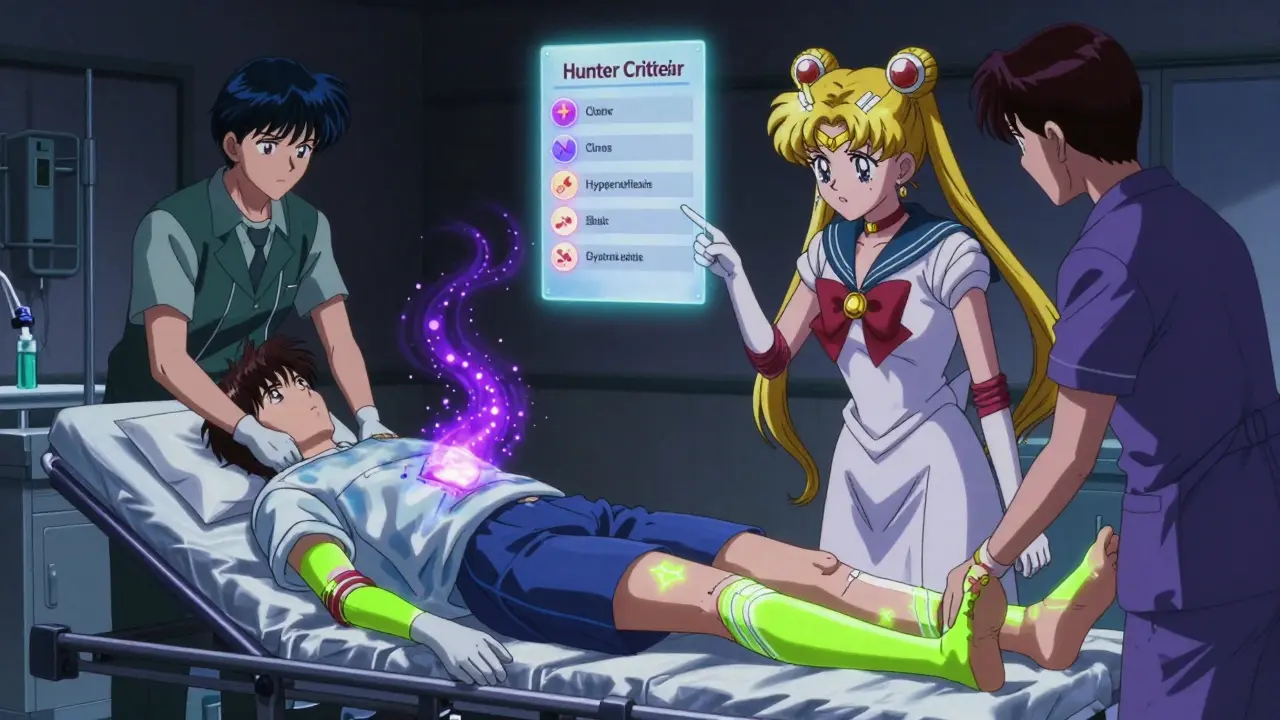
There’s no blood test that confirms it. No magic number. Diagnosis is based on symptoms and history. That’s why the Hunter Criteria exist - a simple checklist doctors use to spot it. If you have spontaneous clonus? That’s enough. If you have tremor and hyperreflexia? That’s enough. You don’t need to wait for a lab report.
How to Prevent It
The best treatment is prevention. And it’s simple:
- Never mix antidepressants: Don’t switch from one SSRI to another without a two-week gap. Don’t add SNRIs or MAOIs without a specialist’s approval.
- Check every new medication: Tramadol, fentanyl, dextromethorphan (in cough syrup), triptans (for migraines), and even some herbal supplements like 5-HTP or L-tryptophan can trigger this. Always ask: "Is this safe with my antidepressant?"
- Know your washout periods: If you’re switching to an MAOI, you need to wait at least 14 days after stopping any SSRI or SNRI. No exceptions.
- Keep a list: Write down every pill, supplement, and OTC med you take. Bring it to every appointment. A 2024 study showed that patients who did this cut their risk of serotonin syndrome by 62%.
- Teach someone: Tell a family member or friend the signs. If you can’t speak, they need to know to take you to the ER.
Why This Keeps Happening
More people are on antidepressants than ever. In 2024, emergency visits for serotonin syndrome rose 22% year-over-year. Why? Because we’re treating complex mental health conditions with multiple drugs. A patient might be on an SSRI for depression, a triptan for migraines, and tramadol for chronic pain. All three are fine alone. Together? They’re a bomb.
And doctors aren’t always trained to see it. A 2023 American Psychiatric Association study found that nearly one in four cases are missed - because the symptoms look like anxiety, flu, or drug withdrawal.
But here’s the truth: serotonin syndrome doesn’t care how smart you are or how careful you think you are. It only cares about the total serotonin load in your body. One extra pill. One wrong combination. One hour too late.
What You Should Do Today
If you’re on an antidepressant:
- Check your medicine cabinet. Do you have any OTC meds with dextromethorphan? Any painkillers like tramadol? Any migraine meds like sumatriptan?
- Call your pharmacy. Ask them to run a drug interaction check for all your current meds.
- Print out the Hunter Criteria symptoms. Keep them on your fridge or phone. Show them to someone you trust.
- Ask your doctor: "Could any of my medications cause serotonin syndrome?" If they hesitate - get a second opinion.
You don’t need to be scared. But you do need to be informed. Serotonin syndrome isn’t a myth. It’s a silent threat. And the only thing that stops it is knowing the signs - before it’s too late.
Can serotonin syndrome happen from one antidepressant alone?
Yes, but it’s rare. Most cases happen when two or more serotonergic drugs are combined. However, taking a very high dose of a single SSRI or SNRI - especially in someone who’s sensitive - can still trigger serotonin syndrome. Overdose isn’t always intentional. Sometimes, people accidentally take double doses, or their metabolism slows down due to age or liver issues.
How long does serotonin syndrome last?
Mild cases usually resolve within 24 to 48 hours after stopping the offending drug. Severe cases may take up to a week, especially if there’s muscle damage or organ stress. With proper treatment - including cyproheptadine and cooling - most people recover fully. But if treatment is delayed, complications like kidney failure or seizures can extend recovery time significantly.
Are all antidepressants equally risky?
No. SSRIs and SNRIs are the most common culprits, but MAOIs are the most dangerous when combined with other drugs. Some SSRIs like fluoxetine (Prozac) stay in your system for weeks, so even if you stop it, the risk lingers. Newer drugs like vortioxetine or vilazodone may have lower risk, but data is still limited. Never assume a drug is "safe" just because it’s newer.
Can I use herbal supplements with antidepressants?
Avoid them. St. John’s wort, 5-HTP, L-tryptophan, and even large doses of omega-3s can boost serotonin. These aren’t regulated like prescription drugs. One woman in a 2024 study developed serotonin syndrome after taking St. John’s wort with her SSRI - she thought it was "natural," so it was safe. It wasn’t.
Is serotonin syndrome the same as neuroleptic malignant syndrome?
No. They’re often confused, but they’re different. Neuroleptic malignant syndrome (NMS) is caused by antipsychotics, develops over days or weeks, and causes slow, stiff muscles with low reflexes. Serotonin syndrome happens fast, causes jerking muscles and overactive reflexes. NMS has high creatine kinase and low temperature; serotonin syndrome has high temperature and normal or low CK. Mistaking one for the other delays life-saving treatment.
Steven Pam
February 24, 2026 AT 13:56Also, if you're using St. John’s wort because 'it's natural'-no. It's not safer. It's just unregulated poison with a hippie vibe.
Erin Pinheiro
February 26, 2026 AT 04:47Larry Zerpa
February 27, 2026 AT 10:14Also, MAOIs aren’t 'older' - they’re underutilized because of bad teaching and fear. They’re often the *best* option for treatment-resistant depression. Don’t demonize them because you don’t understand them.
Nandini Wagh
February 27, 2026 AT 22:28stop scaring people. not every tremor is a death sentence.
Holley T
March 1, 2026 AT 13:33So I looked it up myself. Found out that my migraine med and my antidepressant are a known combo. I stopped the triptan cold turkey. No warning. No taper. Just… gone.
And now I’m terrified. What if I already damaged something? What if I’m already in the early stages? I don’t have symptoms. But I feel it. Like a whisper in my bones.
Why is this not standard? Why is this not on the pill bottle? Why is this not taught in med school? Why do we treat mental health like it’s a side gig? I’m not overreacting. I’m just finally awake.
Ashley Johnson
March 1, 2026 AT 21:43stop taking your meds. go to the chiropractor. eat organic kale. pray. it'll fix everything. 🌱
Lillian Knezek
March 2, 2026 AT 15:43Maranda Najar
March 3, 2026 AT 13:28Let us not mince words: this is not an accident. It is a consequence of a healthcare system that commodifies human life. We treat depression as a line item on an insurance form. We treat patients as data points. We treat doctors as order-takers. And in the silence between the prescription and the pill bottle, someone is dying.
I have lost a friend to this. She was 28. She took a single dose of tramadol because her back hurt. She didn’t know. No one told her. She went to sleep. She never woke up.
This post is not a warning. It is a eulogy. And if you’re reading this and you’re not sharing it - you’re complicit.